
The Phenomenology of Nyarlathotep
An anti-philosophical “philosophical” investigation of Wonderful Everyday (Subarashiki Hibi/Subahibi) as well as Tsui no Sora.

Obviously, this post will spoil Subahibi and Tsui no Sora (both the 1999 version and the Remake).
You can also read this post in:
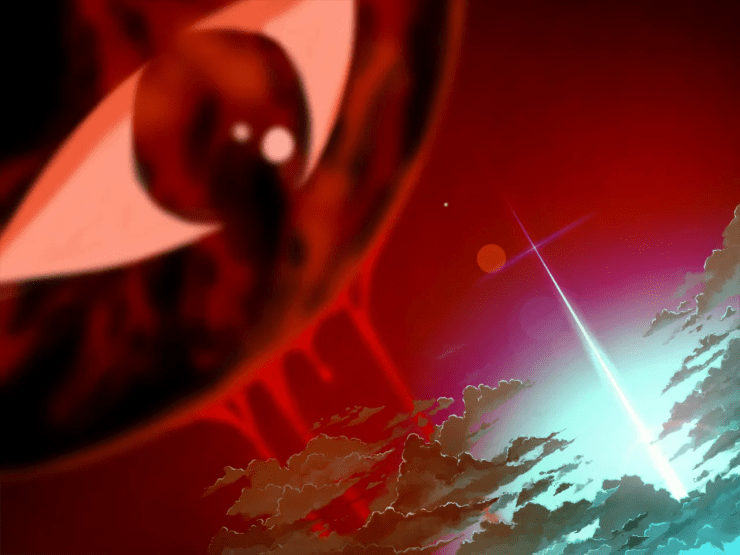
A major difficulty with the 2010 visual novel Wonderful Everyday: ~Discontinuous Existence~ (AKA Subarashiki Hibi ~Furenzoku Sonzai~, or, Subahibi) is that, despite being first and foremost a work of art that demands the usual habits of a good art critic—emotional honesty and aesthetic openness—it also goes out of its way to invite the distant and abstract pose of a philosopher. This is a game where characters quote and discuss famous philosophers at length. Its most famous catchphrase and thematic heart—the exaltation to “live happily"—is a riff on an excerpt from Ludwig Wittgenstein, one of the most striking and bold philosophers of the 20th century. This means that exercises in bare literary or artistic analysis of Subahibi, no matter how excellently done, tend to appear somewhat less expansive and wide-reaching than the material that they purport to analyse.
On account of this challenge, I have only ever felt like it was proper to take little bites out of Subahibi—to snack on its ideas, like they are small pieces of liqueur chocolate. Doing anything further presented a task that had a certain unboundedness to it that is not conducive to how I ordinarily wish to write about art. In the case of discrete media analysis—even with works that present very complex or expansive themes, and even in those cases on this blog where we have gone above and beyond with comically large posts—it is quite possible for the critic to limit themselves to a particular lens or element of the work. But what follows will not be such a self-contained literary analysis of Subahibi. This will not be a review of Subahibi’s place within a bounded artistic framework or lens. It will be an open-ended response to the concepts and worldview that comes across in the whole of that fictional work.
Unfortunately, this approach will also have the side-effect of sterilising Subahibi’s uniquely artistic value. The power of art is exactly that it can exist in a state of flux and indeterminacy which is inaccessible to a philosophical treatise. Even when an essay lands on a conclusion that rejects certainty or embraces ambiguity, it still unavoidably stakes out a position on the validity of certainty itself. Set next to the cold and inert pursuit of truth, the artist retains an enviable luxury: the artist can get inside the experience of thinking beyond understanding, and bring its essential truth as an experience to light. Subahibi definitely “says things” about reality, and we will centre these claims in our own approach to the text. However, in doing so, we will lose our connection to the opacity and liquidity of human experiences that can only come through in a work of art. This chiefly means that when we transform Subahibi into a specific worldview to be examined philosophically, we will be locking in place something that is better understood in its fluidity. There will be occasions when we lay out certain “claims” as being “made” or “argued for” by the game, and some readers may find it less than obvious that Subahibi presents anything so conclusive as these resultant positions. They might find the picture of the work that appears below to be overly simplified and reductive. I can only say that I tried my best to minimise this problem while recognising that it is an inevitable feature of the subject matter and methodology of the post, as well as my own flaws as a writer.
The ground of our discussion will be far more fundamental and structurally expansive than even the already fairly pedantic and long-winded output typical of this blog. We will have to let this text—everything in it, whether diegetic or didactic—congeal into a unitary whole that we can, in turn, confront with our own arguments about the nature of the world on a similar scale. This necessarily unbounded methodology presents clear challenges. For one, this post will be dense and hard to read—more so than normal. For another, it has ballooned out to such a scale that I worry as to whether I have succeeded in threading it all together. Nonetheless, I believe the end result remains worthwhile even in light of these limitations.
The structure of the argument will proceed as follows:
In Part One, we will draw out the philosophy of Subahibi as it is presented by the game and by its historical context.
In Part Two, we will dive into a slice of political theory on cult dynamics and terrorism as an added interpretative context for the events depicted in Subahibi’s plot.
In Part Three, we will answer the solipsistic tendencies in Subahibi with our own attempt at an onto-political argument for phenomenological materialism.
Unfortunately, my attempt to directly respond to Subahibi will only properly arrive after the above groundwork has been completed. But for the moment, I would like to offer a primer on the overall point that this essay will gesture towards. And this will come by way of an explanation of its subtitle: This essay, like Subahibi itself, will centre on a number of “philosophical” concepts. We will step beyond the authors directly cited in the game itself and consider a wide range of thinkers from across the world. However, at the end of this sojourn, our overall standpoint will amount to an argument against philosophy as the proper frame in which to situate the themes and motifs that appear in Subahibi. We will suggest that Subahibi is limited by the conditions that push it to look inwards towards the philosophical mode of contemplation as the means to “live happily” in a contemporary capitalist society. Life, whether lived happily or not, is not located in the brain. Life is lived in our physical world which we share with others. And the crisis of our times is, correspondingly, a crisis of political action in the world, not philosophical thought in the brain.

Part One – The Void Beyond the Brain
Wonderful Everyday: ~Discontinuous Existence~, or as it is often known, Subahibi, is a Japanese denpa horror visual novel developed by KeroQ and released in 2010. It features a scenario primarily written by Sca-Di (SCA-自), with assistance from Ayane, Chitose, and Kenichi Fujikura. Technically speaking, Subahibi is a kind of remake or reimagining rather than an original story. Its core plot closely follows the events of Tsui no Sora—a visual novel from a decade prior (1999), also made by KeroQ and Sca-Di. And as with Tsui no Sora, Subahibi’s structure is a kind of anthology narrative, where the breaks in continuity offered by each chapter rely on a shift in narrator and perspective, rather than depicting entirely different events in the narrative. Tsui no Sora in particular can be described as a game that tells the same story several times over from multiple points of view. Subahibi has a few exceptions to this formula, but it maintains an essential interest in the problem of exploring multiple perspectives on a single event.
The centrepiece of the action in both games is a spontaneous doomsday cult that forms in response to the suicide of a student named Zakuro Takashima. The cult takes up residence within an unused underground section of Kita High School, and is led by a teenaged boy named Takuji Mamiya. This impromptu organisation is oriented around a prophecy that the world will end on the 20th of July (in 1999 and 2012 respectively, depending on the game), and which quickly balloons in size during the week leading up to the apocalyptic date in question. While each of the games utilise this scenario to develop overlapping stories centred on similar horror elements, there are also significant differences in their approaches to this same overall motif.
One particularly illustrative example of these variations can be found in the character of Tomosane Mamiya. Tomosane appears to suffer from a dissociative condition such that several characters who are discrete, separate people in Tsui no Sora (Takuji Mamiya, Yukito Minakami, Kotomi Wakatsuki) only strictly exist in Subahibi through Tomosane’s perspective. He himself also occupies multiple identities and perspectives throughout, with the Chapters for Yuki Minakami, Takuji Mamiya, and Tomosane Yūki taking place “within” the same physical body of “Tomosane Mamiya.” In this sense, Subahibi transforms Tsui no Sora’s “[telling] the same story several times over from multiple points of view” into “telling the same story several times over from the ‘same’ point of view with the appearance of multiple points of view.” This allows the game to use the expectations set by its format to develop an implicit commentary on identity, subjectivity, and perspective.
Structurally speaking, Subahibi is made up of seven main segments: (1) Down the Rabbit Hole I, (2) Down the Rabbit Hole II, (3) It's my Own Invention, (4) Looking-glass Insects, (5) Jabberwocky I, (6) Which Dreamed It, and (7) Jabberwocky II. There are five total narrators, with each respectively corresponding to one of these chapter titles (repeat titles have repeat narrators). There is, however, a more conceptual way of organising these chapters.
Subahibi has two overriding storylines: Firstly, there is the sequence of events that result in Takuji Mamiya’s cult. Secondly, there are the mysteries that culminate in the revealed identity of Tomosane Mamiya. Launching off from this segmentation, we can break the chapters up into one group that primarily deals with the cult plot, and into a second group that primarily deals with the Tomosane plot. Chapters one through three belong to the former group. Chapters five through seven belong to the latter group. Chapter four lies in an intermediate position, where it begins to address the revelations of the Tomosane plot whilst keeping a fundamental thematic connection to the cult plot. Setting off on our inquiry into Subahibi will necessitate a pair of sequential analyses of the themes contained in each of these two divisions. However, Subahibi does not end after chapter seven. It also features an epilogue chapter titled Tsui no Sora II and a bonus chapter called Knockin’ on Heaven’s Door. Of these two, the epilogue chapter is of significant importance for our analysis. We will therefore append it as a third topic for our consideration.
First division: Everyday nihilism as cosmic horror
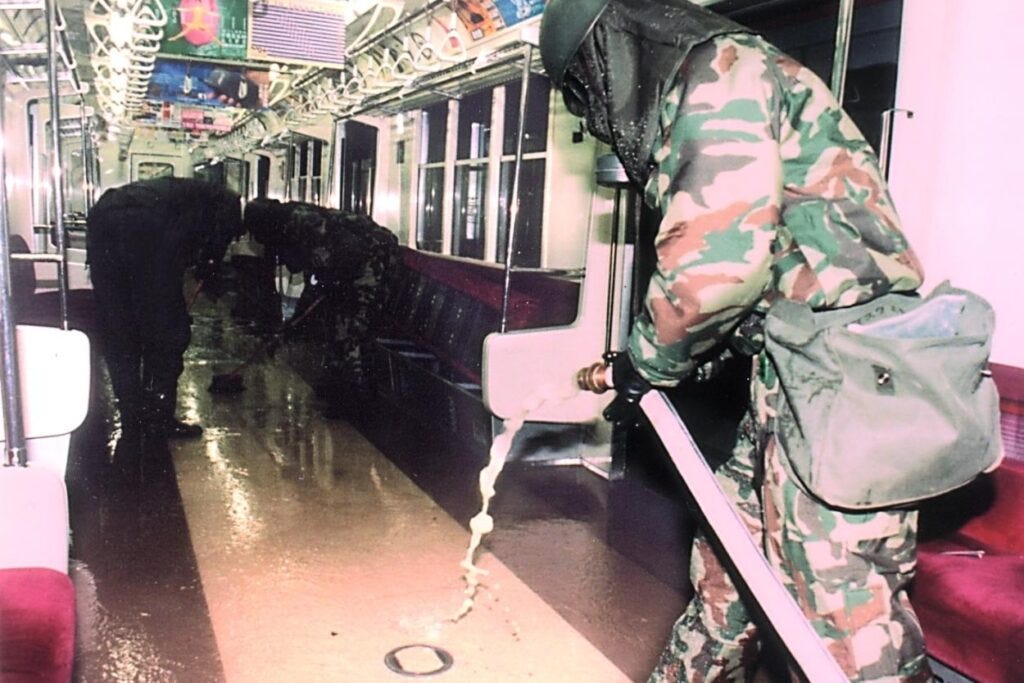
On the 20th of March, 1995, fourteen people were killed and thousands more were seriously injured when the Japanese doomsday cult, Aum Shinrikyō, attacked the Tokyo subway line using sarin gas—a military-grade nerve agent. This came just two months after approximately five-thousand people were killed in the Great Hanshin earthquake—Japan’s second-most lethal earthquake of the 20th century. The middle of the 1990s also saw the entrenchment of the “Lost Decades” of economic stagnation and the “freeter” (underemployment) crisis.
Later, in February 1997, the 14-year-old boy Shinichiro Azuma assaulted two younger children in the Kobe area. His crimes quickly escalated from there as he continued attacking children throughout the first half of 1997. In March 1997, he even bludgeoned a 10-year-old girl to death. And most dramatically, in May 1997, he strangled an 11-year-old boy, beheaded him, and displayed his head at a local elementary school to taunt the public. Once he was caught, the young age of the culprit and his nihilistic (lack of) motives naturally led to frenzied media coverage.
It is impossible to properly situate Tsui no Sora’s poignant sense of apocalypticism and dread without reference to the atmosphere of sheer cosmic misfortune that dominated Japan in the era leading up to its release. To say that Tsui no Sora is “based on” the Aum incident understates the case. Tsui no Sora bathes in the zeitgeist of the late 1990s and its rapid succession of extreme incidents. It marinates in the palpable sense of hopelessness and directionlessness of a youth culture where the oncoming end of the millennium felt equivalent to the end of all meaning. It depicts a time when the sights and sounds of ordinary Japanese city life took on the same feeling as Gustaf Johansen uncovering the nightmarish city of R'lyeh. Subahibi, for its part, as a kind of reimagining of this same story, must be understood in its relationship to—even in the sense of explicit distance from—this historical zeitgeist.
In the immediate wake of the Aum incident, the sociologist Shinji Miyadai quickly published the 1995 book, Living an Endless Everyday Existence: A Comprehensive Guide to Overcoming Aum. On account of its easy readability and fairly original thesis, the book had a lasting influence on interpretations of the Aum incident. Miyadai rejects the popular theories that explained Aum’s violence via the decline of traditional morality or via new “anti-reality” cultural trends such as anime and otaku culture. Instead, he suggests that cults like Aum are a misallocation of people’s capacity for ethical conscientiousness. Such ethical awareness leads to utopian aspirations for an absolute form of goodness, but these desires are misplaced in a secular age that cannot live up to the pre-modern ideal of absolute cosmic justice.
For Miyadai, humans naturally desire transcendence or an “outside” beyond themselves that they can act upon and through. However, the progress of humanity has gradually produced an inescapable “inside” realm made up of technologically mediated, subjectivised states of existence. Notably, Miyadai argues that this progress is itself a good thing. He also highlights the empirical reality that social and technological progress has continued throughout much of human history, and that it cannot be simply frozen or reversed indefinitely. The problem lies in the fact that, even if progress is both desirable and inevitable, it nonetheless produces a dangerous kind of ontological isolation that frustrates the natural desire for transcendent action. Utopianism and cult-like extremism are each symptomatic of this frustration. Therefore, Miyadai calls for the negation of these symptoms through a political embrace of an “endless everyday existence,” rooted in the simple and relativised happiness of daily life in a stable capitalist society.
Tsui no Sora is responsive to this mindset in several interesting ways. The starting narrator of Tsui no Sora is Yukito Minakami. And one of Yukito’s most significant flaws in the story is that his common sensical attachment to the logic of everyday existence blinds him to the danger posed by Takuji and his cult. Because Yukito is so steadfastly committed to the seemingly obvious fact that the world will not end on the 20th of July, he fails to appreciate the contagiousness of the nihilism and apocalypticism that spreads throughout the school after Zakuro’s death. The end result of this miscalculation is that Yukito is unable to respond when his friend and love interest, Kotomi Wakatsuki, is kidnapped, tortured, and raped by the cult. It is fair to say that Yukito’s experiences in the story form an implicit criticism of the naïveté contained in the endless everyday existence mindset: Yukito is the most conventionally thoughtful and “correct” character in Tsui no Sora, but these attributes are rendered useless, or even harmful, given the frenzied social collapse around him.
Subahibi has its own analogue to Tsui no Sora’s first chapter, but it appears in the game’s second chapter, not its first. Subahibi’s second chapter has the same surface appearance as Tsui no Sora chapter one, with minor variations in the cast (Yuki Minakami as the female version of Yukito, for example). However, its thematic meaning is also shifted subtly. The presence of Subahibi’s own first chapter is a key culprit behind this difference. In Subahibi chapter one, Down the Rabbit Hole I, Yuki experiences a lighthearted, romantic school life in a world where Zakuro never commits suicide and where the Takuji cult never appears. Yet, this ideal world gradually unravels and comes to seem more like an elaborate intertextual structure—built up of allusions to Cyrano de Bergerac by Edmond Rostand, The Brain is wider than the Sky by Emily Dickinson, Night on the Galactic Railroad by Kenji Miyazawa, and Through the Looking-Glass (as well as other related stories and poems) by Lewis Carroll—rather than anything concrete or real.
There are a range of viable plot interpretations that one can bring to the first chapter of Subahibi—especially in light of its playful attitude towards the concept of reality. But at least on a thematic level, the chapter’s most visible effect is to present an endless everyday existence, which we can interpret in the Miyadai mode. It thereby serves as an absolute contrast to the extraordinary events that occur in the subsequent second and third chapters. However, where Yukito’s obliviousness and rootedness in everyday life was a clear personal shortcoming in Tsui no Sora, Subahibi begins its divergence from the prior text by taking a more equivocal stance on the danger of everyday happiness. The game’s overriding motto—to “live happily”—affirms such a lifestyle more than it condemns it. Yuki’s lesbian romance paradise (chapter one) admits upfront that it is unlikely to be real in a conventional sense. But as the game unfolds, it also becomes clear that this unreality is less of a problem than it might originally seem.
In the world of the first chapter, “there is one singular girl. No, there is a girl who is the world itself.” And that girl must find and return to her beginning and her end in the sky. Moreover: “The Brain — is wider than the Sky — For — put them side by side — The one the other will contain With ease — and You — beside.” Where can one find this sky with the girl who is the world? On the roof. And “by roof, you mean a place where you can see the sky.” On such a roof, Ayana Otonashi “came to see.” But “see what? The sky?” Not exactly, “the entire world. […] What do you think of the scenery you can see from this rooftop? […] You can see the city. Because this is the rooftop, you can see the sky, and you can see the city. […] You can’t see the city that lies beyond that, or what lies even further beyond that still. […] What if you could know what lies beyond the scenery you see, and beyond that still, and still further beyond that? The endless succession of beyonds.”
Unfortunately, we cannot simply translate a specialised vocabulary like this into a commonplace form of meaning that could tell us what is happening canonically in Subahibi chapter one. But we can at least add our interpretation to the chapter within the boundaries of its own vocabulary. The endless everyday existence of Subahibi’s first chapter is enclosed within the inside of the sky. And by that, we mean something that fits within the brain: “For — put them side by side — The one the other will contain With ease — and You — beside.” The world is a singular girl, and therefore the question is not so much what is happening in the chapter, but where and who. This endless everyday existence is not falsifiable in the manner of a what. It is the horizon of a sky, and centres on the search for the beginning and end of that same sky. Ayana, by contrast and for her part, is looking at the transcendent—at the outside beyond that sky, at the End Sky. Her question is whether the End Sky is even a beyond at all, or whether it instead fits within the brain like any sky.
This is all to say that Subahibi uses its commentary on the concept of reality to make a partial break with Tsui no Sora’s criticism of Yuki(to) for remaining within an endless everyday existence. In and of itself, an endless everyday existence is not any more or any less oblivious to the “realities” of its surrounding zeitgeist. It simply corresponds to one possible standpoint from which to view the sky. But the implied equivalency of such standpoints is precisely why chapter one’s positive interpretation of an endless everyday existence must be inverted by the very next chapter. Subahibi chapter two revisits Tsui no Sora’s critique of the endless everyday. Yuki undergoes the same traumatic failure to prevent the kidnapping and grotesque abuse of her friend and potential lover—in this case, named Kagami Wakatsuki. However, it is also at this juncture that the chapter offers another confrontation with the problem of unreality. Inconsistencies and impossibilities pile up in the story that we are experiencing through Yuki’s perspective until, finally, Kagami’s definite presence disintegrates and a stuffed animal appears in her place.
With the benefit of later chapters, we can point out that the crime in question did not exactly occur in a literal—or at least in an objective—sense. “Kagami” was only ever a stuffed animal in the possession of Tomosane Mamiya’s younger sister, Hasaki Mamiya. Moreover, the instigator behind the “torture” of “Kagami” was Takuji—an alternate identity who shares Tomosane’s body along with Yuki in the first place. The punishment that Yuki suffers for failing to face up to the cult is clouded over by the same kind of opaque sense of unreality that infused Yuki’s comparatively successful endless everyday existence in the first chapter. Put another way, the problem of reality supersedes the distinction between the everyday and the extraordinary. In Subahibi, the cult no longer corresponds to the reigning truth of the historical moment, whereas the cult in Tsui no Sora was given a privileged viewpoint by the crisis of the 1990s. This indeterminacy is made exceedingly clear once we view the cult from the inside during chapter three of Subahibi.
The third chapter of Subahibi takes up Takuji’s perspective. Where chapter two was centred on how to face up to the cult phenomenon from its outside, this third chapter concerns itself with the sociological and psychological formation of the cult from its inside. Takuji is a deeply isolated and weak person, as well as the victim of severe bullying. He is an archetypal otaku in his heavy dependence on fiction. And he also spends much of his time totally absorbed in a range of power and sex fantasies. Takuji’s sense of victimisation and his extreme inwardness can be read together by their shared connection to ontological isolation—that is, to the condition that Miyadai identifies with the subjectivity of our technologically mediated society. It is not just that Takuji happens to suffer pain or misfortune in a generic way. He suffers from a specific form of world alienation, rooted in the sensation that his suffering originates in the cold and foreign world of “common sense.” The technologically mediated world of mass society proceeds autonomously without his input, and Takuji therefore feels as though others only exist beyond the border of a fully inaccessible outside.
At least on a psychological level, the immediate catalyst behind Takuji’s attempt to establish a cult is the one-two punch of, firstly, his impression of a romantic connection with Zakuro (this is not entirely untrue, but it is still rooted in a misunderstanding), followed by, secondly, her death. By their nature, love and reproduction are structurally infused with the meaning of ontological transcendence. Takuji perceives Zakuro as the only vessel that would allow him to escape—eject, shoot, ejaculate—out of himself. (This is of course libidinal and gendered—but that topic is better left to other essays about other stories.) To take an overly pseudo-psychoanalytic framing, Takuji’s desire to reproduce boomerangs back to him in the form of a grotesque encounter with death and mortality. This scares him shitless and he retreats into the depths of his “secret base” in an unused underground section of Kita High School. There in the darkness, he, as Ayana puts it, comes into contact with Nyarlathotep—the Crawling Chaos. But at least in Takuji’s mind, this is actually an encounter with the “Magical Girl Riruru-chan,” who helps him to transcend his prior existence and become the “Saviour.”
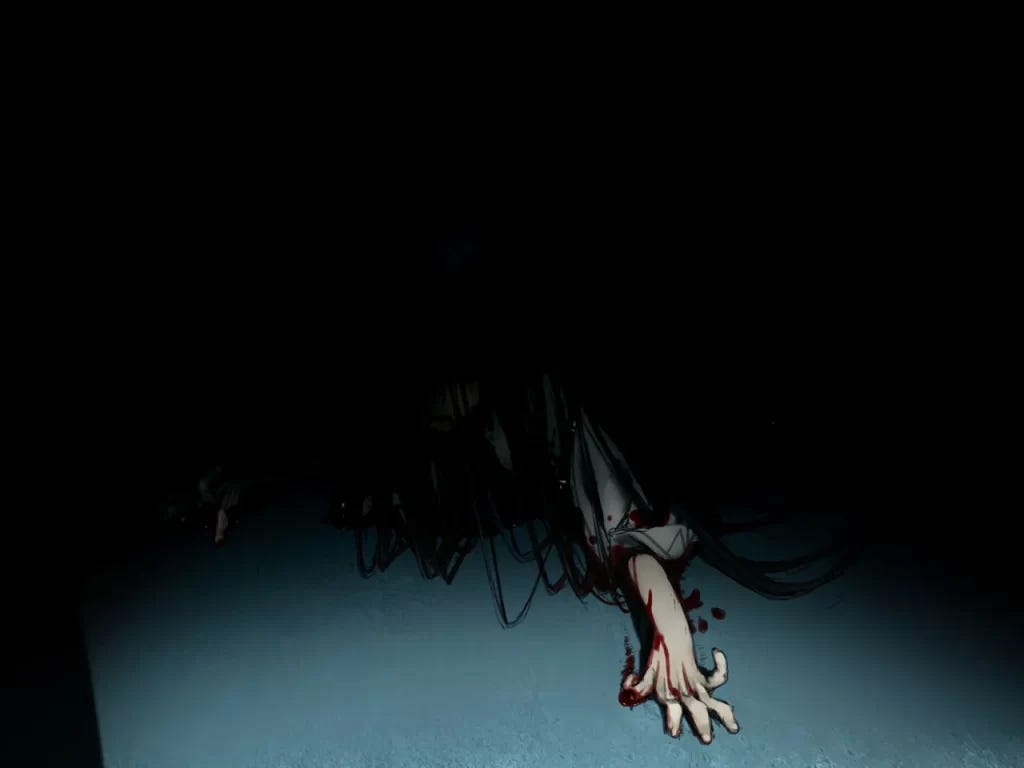
Takuji is the one and only Saviour, but the majority of other cult members go through a comparable journey. Even prior to Zakuro’s death, many of the students of Kita High School were presented as being dissatisfied with their endless everyday existence. They were drenched in anxiety—that is, as Heidegger defines it, fear with no object or directionless fear. But after Zakuro’s death, this anxiety acquires a definite object in the idea that their endless everyday existence could transform into a sudden and meaningless death. Their anxiety therefore actualises into a concrete sense of terror. Such terror explodes out in the utopian desire for transcendence that is identified by Miyadai. Takuji’s prophecies easily play on this desire since they are explicitly structured in terms of “escape” from the corrupted “false world” and entry into a perfect “real world.”
For her part, Zakuro’s own chapter happens to feature a total divergence in its events based on the choices of the player. Even when the game features choices in the other chapters, the variations are usually either superficial or are limited to just the conclusion of the narrative. The comparatively darker route within Zakuro’s chapter is closely connected with the cult plot, whereas the happier route is most related to the Tomosane Mamiya narrative. This is intuitive enough, since the darker route follows the general skeleton of the Zakuro chapter in Tsui no Sora. In sticking with typical visual novel conventions, we will hereafter call Zakuro’s darker route the “true end,” since it is canonical to the other chapters. The alternative will instead be the “good end.”
The Zakuro true end is a kind of thematic antecedent to Takuji’s cult—and this is, in all likelihood, why the Zakuro chapter originally preceded the Takuji chapter in Tsui no Sora. Zakuro, like Takuji, is an insulated and victimised person who often retreats into fictional contexts as a survival mechanism. This parallelism is not just a matter of connecting these two individuals specifically, even if their intersection is a key feature of the story. It is also that Subahibi depicts a kind of world alienation as the default mode of existence in contemporary Japanese capitalism. Only exceptionally headstrong personalities such as Yuki are able to successfully navigate this alienation and apocalypticism to any appreciable degree. Relatedly, one of the primary points of differentiation between Zakuro’s story and Takuji’s lies in the fact that Zakuro encounters and then falls in love with Yuki—who, misleadingly, exists in the guise of Takuji via the body of Tomosane. Or to put things in a more conceptual light, we might say that Zakuro’s point of difference lies in her capacity to sincerely fall in love, in a manner that is not true of the cynical and narcissistic Takuji.
Zakuro seeks an escape from her endless everyday existence, but she also has a fundamentally outer-directed desire to incorporate others into this escape. Insomuch as she wants to reach a transcendent new world, she longs for a world that she can share with others—especially with Yuki, in the manner that we see in Down the Rabbit Hole I. In and of itself, the problem of love and otherness, within the horizons of the extreme subjectivity inculcated by an alienated endless everyday existence, is an exceptionally important motif during the first four chapters of Subahibi.
Yuki’s rootedness and steady temperament gives her an unusual capacity for facing up to the challenges involved in living an endless everyday existence. However, the flipside of her resistance to the alienating structure of contemporary life is a certain blindness—or even outright stupidity—when it comes to others and their own dislocation from the world. Takuji exemplifies such dislocation, being so extreme in his subjectivity and alienation that even the dramatic acts of transcendence and unity undertaken within the context of his cult are at most fleeting and superficial experiences for him. Zakuro here offers a curious intermediating point between these positions, since whether or not she continues to live an endless everyday existence depends on decisions that are left to the player: if she faces enough suffering and horror, she can succumb to alienation and nihilism, leading to the true end where she reaches for transcendence through death.
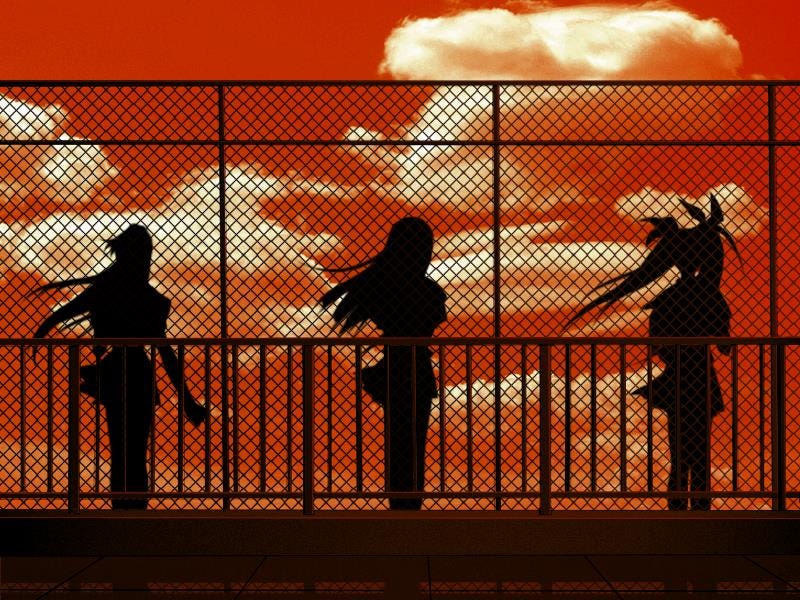
The sheer contingency that this structure introduces into Zakuro’s story is a significant point of departure between Tsui no Sora and Subahibi. In Tsui no Sora, Zakuro begins at rock bottom: She is suicidal from the outset and the narrative simply tracks her unerring journey from depression to an apocalyptic death fantasy. As for Subahibi, Zakuro’s newly indeterminate fate shines a light on certain nuances that appear within the text’s reinterpretation of nihilism. While it agrees with Tsui no Sora that ontological isolation and alienation are the default condition of an endless everyday existence in contemporary Japan, it takes much greater care to draw attention to how the most horrific forms of alienation—those that bring about the hellish desire for absolute transcendence and death—flow from concrete sources of misery and cruelty, as opposed to Tsui no Sora’s ambiguous, generalised atmosphere of doom.
Second division: The mind–body problem is wider than the sky
A cornerstone image that sustains the rest of Subahibi can be found in the famous graphic of Yuki standing atop a skyscraper in the middle of Tokyo—her eyes absorbed by the awe-inspiring, wide open azure sky above her, as she smokes a cigarette and thinks over the meaning of existence. This moment also features a more figurative undercurrent: it expresses something like the unity between an isolated individual thinker and the boundless world of the sky. Beyond anything else that we might try to say about the game, this metaphor cuts straight to the beating heart of Subahibi as both an aesthetic and a philosophical experience.

Subahibi places a lot of weight on the idea of the sky. Within the philosophical vocabulary of the story, the sky is a stand in for the enclosed infinity of the world itself. This is spelled out during the climax of Jabberwocky II, when Yuki and Tomosane stare at the universe and think over how the endless expanse of a starry night can be captured within the limited horizon of their individual brains. But even prior to this, a considerable amount of time is spent throughout the story on various rooftops contemplating the different skies that characters see. Some people see the same kind of limitless blue sky as Yuki; they are taken in by the boundless potential of a world whose only limit is the beholder themselves. Others instead see the End Sky—a sky that heralds a life lived within the boundaries of a determined end point, such as the 20th of July, 2012.
The young Tomosane and Yuki of Jabberwocky II are not actually the first characters in the story to grasp the endlessness of the sky in this manner. Earlier in that same chapter, Hasaki has her own memorable and poignant encounter with the sky. After the death of her father, she wanders to the same hill where the climax of the story is to later take place. The sky she sees from there is roughly the same kind that Tomosane and Yuki witness later, and she therefore draws a related conclusion: The unending infinity that Hasaki finds in the starry sky stands in sharp distinction to the boxed-in world of certainty which she had been promised by the adults around her. She had been told that her father’s death meant that he was waiting in the stars—that death lies in the sky. She instead learns that those stars are impossibly far away from human life. In essence, she learns that human life is the limit of the world, and that humans can never reach beyond this limit to their death.
Subahibi’s use of phrases such as “the limit of the world” carries a specific meaning in reference to Ludwig Wittgenstein’s early philosophical work, Tractatus Logico-Philosophicus (TLP). We can identify declaration 5.6 of the TLP—as well as the relevant sub-declarations that follow from it—as particularly relevant to this point. These read:1
(5.6) The limits of my language mean the limits of my world.
(5.61) Logic fills the world: the limits of the world are also its limits. We cannot therefore say in logic: This and this there is in the world, that there is not. For that would apparently presuppose that we exclude certain possibilities, and this cannot be the case since otherwise logic must get outside the limits of the world: that is, if it could consider these limits from the other side also. What we cannot think, that we cannot think: we cannot therefore say what we cannot think.
(5.62) This remark provides a key to the question, to what extent solipsism is a truth. In fact what solipsism means, is quite correct, only it cannot be said, but it shows itself. That the world is my world, shows itself in the fact that the limits of the language (the language which only I understand) mean the limits of my world. (5.621) The world and life are one.
(5.63) I am my world. (The microcosm.) (5.631) The thinking, presenting subject; there is no such thing. If I wrote a book "The world as I found it", I should also have therein to report on my body and say which members obey my will and which do not, etc. This then would be a method of isolating the subject or rather of showing that in an important sense there is no subject: that is to say, of it alone in this book mention could not be made. (5.632) The subject does not belong to the world but it is a limit of the world. [...]
(5.64) Here we see that solipsism strictly carried out coincides with pure realism. The I in solipsism shrinks to an extensionless point and there remains the reality co-ordinated with it. (5.641) There is therefore really a sense in philosophy that we can talk of a non-psychological I. The I occurs in philosophy through the fact that the "world is my world". The philosophical I is not the man, not the human body or the human soul of which psychology treats, but the metaphysical subject, the limit—not a part of the world.
This excerpt is liable to certain misinterpretations if it is read absent the logical atomism that is developed in the preceding declarations of the TLP. Similar problems will also occur if one excludes the enclosing declaration 5 (“propositions are truth-functions of elementary propositions”) from their analysis. But whether we call Subahibi’s reading of the early Wittgenstein “wrong” or merely “creative,” we must first approach the game’s worldview in light of its own choice of such a reading.
As we have discussed, Subahibi’s first four chapters are a reimagining of Tsui no Sora. Insomuch as Tsui no Sora is a direct and fairly pessimistic depiction of the apocalypticism of the late 1990s, Subahibi revisits and rearticulates this object in order to turn the question around and examine the problem of subjectivity. We can think of the existential, abstract motifs that appear in the later half of Subahibi as an additional layer that rests atop the foundation of Tsui no Sora and its thematic legacy of socio-political atomisation in the post-Aum age. When Ayana paraphrases Wittgenstein at Yuki and says, “your limit is the limit of the world. Therefore, I am unable to tell or show you anything which you are not capable of seeing or speaking of,” we need to develop the tools to read this claim in consideration of Subahibi’s layered politico-existential structure.
Yuki herself is a useful example of this process at work. In Tsui no Sora, Yukito is unable to comprehend the conditions of his historical moment. As a result, he becomes blinded by and lost within an endless everyday existence. But since Yuki is instead immanently tied to the body of Tomosane Mamiya, she is “literally” present in the circumstances that Yukito was blind to. Her distance from Tomosane and Takuji is a purely "philosophical" rather than “psychological” phenomenon, in Wittgenstein’s sense. That is, in the sense that the subjective self is “not the [wo]man, not the human body or the human soul of which psychology treats, but the metaphysical subject, the limit—not a part of the world.”
Ayana expands on a related point when she says the following to Yuki:
Minakami, you too are trying to unearth something which you’ve hidden. […] The Wonderful Everyday. […] People live within the eternity of life. […] Life is a closed box. After all, death opens its doors for no-one. If you manage to conceal it, you will know nothing. Just like that, the Wonderful Everyday will be constructed upon the silence whereupon you cannot speak. […] Do you want to go outside? […] To the next world.
(Yuki rejects this provocation and says that Ayana is “starting to sound like Takuji Mamiya.”)
It is difficult to follow Ayana’s argument as given. For this reason, it would be productive to also consider Zakuro’s good end and its encounter with the various identities of Tomosane Mamiya. Because the Zakuro good end quite naturally focuses on Zakuro and Kimika as its primary characters, it is easy to overlook the fact that it is also a kind of hyperbolic good end for Yuki, where she manages to achieve an ongoing endless everyday existence without the suffering and difficulties of the other “routes.” However, Yuki’s precise circumstances throw some doubt upon the actual desirability of this result. Tomosane Mamiya operates through a system of three “souls” in one body (Takuji Mamiya, Tomosane Yūki, and Yuki Minakami). According to Tomosane Yūki’s interpretation, Takuji, who is the current head of the identity system, unconsciously wishes to be taken over by Yuki as his idealised personality (well, that certainly has gender implications). Tomosane’s role is to “defeat” Takuji and install Yuki as the new chief identity. Zakuro’s good end is the only outcome shown in the game where this concept plays out as originally envisioned, with Yuki being reborn as the sole personality occupying the body of Tomosane Mamiya at its conclusion. However, this result also sees Yuki lose her connection to the “objective” world observed by others; she enters an unreal endless everyday existence alongside the Wakatsuki twins, unable to reach Hasaki or any of the other unresolved threads of Tomosane’s past.
If we return to the Wittgensteinian vocabulary that appeared in Ayana’s earlier argument, that will render the problem a little differently. In this framework, Yuki cannot rely on any notion of an objective outside. There is no way for her to speak of any provable “other” beyond her enclosure within an endless everyday existence. Yuki is her own world; she does not belong to the world, but is a limit of the world. The alleged outside is not even an articulable type of absence, since, as in declaration 5.61, “what we cannot think, that we cannot think: we cannot therefore say what we cannot think”—and, in declaration 7, “whereof one cannot speak, thereof one must be silent.” The outside is not “anything” except the silence of non-knowledge. The Wittgensteinian notion of solipsism is not so much an affirmative claim that the outside, which is beyond the limit of the subject, specifically lacks existence. Rather, it is a sceptical claim that the subject is the limit of the world, and that there is therefore no sensible criteria for articulating the silence beyond this limit.
In this sense, a condition or situation that moulds the silence of non-knowing comes to implicitly be capable of changing the apparent shape of the world. On this point, we can return to Ayana’s argument that Yuki’s endless everyday existence is “constructed upon the silence whereupon you cannot speak.” When Yuki loses her experiential connection to Takuji, Tomosane, and Hasaki, it is not as though she has any criteria by which to speak of this shift as a moment of alienation or removal from the “objective” world. From Yuki’s perspective, the world—her world, of which she is the limit—has changed in its concrete and verifiable content. As Tomosane also argues:
There is no exterior or anything. It’s all just the world. It’s all just my world. […] I don’t really feel like I’m alone in the world. You’re right in front of my eyes, so you definitely exist. I would even go so far as to say that Yuki Minakami and the Wakatsuki sisters existed as well, even if they didn’t exist to you. But still, even then, my world ends at the limit of my world. I don’t know anything beyond the limit of my own world. I have no way of knowing anything else. That’s why I’m only me. It’s a bit strange for me to say this after sharing my body with multiple people. No, especially because of that, I can say that I’m no one except myself.
Nobukatsu Kimura amends this description, observing that “even if we had an exterior, it would just be another part of the world we know.” That is, transcendence is impossible because stepping beyond the limits of yourself is simply an act of including the previous outside within a new inside. Looking at the universe places that universe within one’s brain. Yuki’s predicament is something like the inverse of this phenomenon: retreating from knowledge of something that was once known—to hide something, in Ayana’s terms—shoots that something out into the silent non-existence of the inarticulable outside. As a sociological matter, Ayana identifies the endless everyday of contemporary society as just such an expatriation. Contemporary life exiles death and builds up a new life-world atop the silence left in death’s place. Yuki enacts a similar principle in microcosm by living within a world where Takuji, Tomosane, and Hasaki are absent. The Wakatsuki twins, for example, exist precisely atop the silence left by Hasaki’s absence.
Our analysis thus far has disorientingly jumped back and forth across multiple thought trains. The necessity of this manoeuvre lies in the fact that Subahibi itself develops along a series of parallel conceptual tracks. However, a number of these disparate strands are ultimately brought together through the problem of Tomosane Mamiya’s body. Or more exactly, Tomosane is the instrument that Subahibi uses to trace the points of contact between its various thematic paths. Across the Yuki, Takuji, and Tomosane chapters, we see various worlds. These worlds are each, in the sense discussed above, “constructed upon the silence whereupon you [the individual narrators] cannot speak.” The shared embodiment of these individuals demonstrates that these separate worlds are not rooted in a merely physical or psychological sense of subjective difference. Moreover, it is not that different subjects are different parts of the same world. The point is to present a situation that overlaps exactly with Wittgenstein’s notion of the subject as the world—of the world as the terrain constituted by the subject’s limit. Since the identities that constitute Tomosane share the same bodily limit whilst forming entirely different worldly limits, this demonstrates that the limit of the self-world is not reducible to an empirical phenomenon of physical embodiment. Each person can only treat the world as their world, nothing more and nothing less.
The first and central problem is whether accepting the givenness of this subjective self-world automatically entails solipsism. Wittgenstein answers in the affirmative throughout declaration 5.6. However, his acceptance also begs the question of what solipsism means to him, since he also identifies it with “pure realism.” That is, we must ask: even if the world is constituted of one person and one person only—the philosophical subject—does that demote all others to comparative non-existence? At the least, must the solipsist doubt the worlds of others even if they provisionally accept the existent there-ness of others? (“You’re right in front of my eyes, so you definitely exist,” as Tomosane accepts.) One notable excerpt from the conclusion of chapter two offers a hint as to Subahibi’s stance:
The difference between me and the world. […] They’re the same. […] if you stood at the edge of the world, you would probably see the shape of the world just like I do. So you would be the same as the world too. But that really doesn’t make sense. If the world is me, why can’t I see the world that you see? Even though you are in my world, I can’t see the world you see. I’ve never seen the world that you do. They’re like parallel universes that can never cross. […] I can’t see the world you live in. […] But… Is that really the case? […] If every person has been equally allotted one singular world… […] There must be a way for the worlds to become one.
That is, even while accepting solipsism as its ground, there is a degree of openness to the shared ground of the world. This is another point which Subahibi roots in the unique mode of existence that is taken up by Tomosane. While it is true that each individual who shares Tomosane’s body constitutes a separate and irreconcilable self-world, they each depend on their mutual separateness as foundational to their own identities. Put another way, Tomosane’s identity as himself depends on the recognition that the person who appears as Yuki is a demonstrably existent person who can nonetheless be defined negatively as not-Tomosane within the same body. Tomosane accepts himself as his world. Yuki overlaps with himself at such a level that Tomosane cannot doubt her existence. However, she separately constitutes her own world in a silence whereof he cannot speak. The result, as Tomosane puts it, is that “especially because” he is “sharing my body with multiple people,” he is able to “say that I’m no one except myself.” Subahibi builds a ground for solipsism that is curiously accepting of the existence of others.
One effect of this whole stance is that the second half of the story is able to redefine the same division between inside and outside which is so decisive in Tsui no Sora, as well as in the earlier chapters that recapitulate some of the same thematic terrain as that earlier game. Subahibi’s ultimate model of subjectivism rejects the concept of transcendence and the outside in general. Everything is one contiguous inside in the sense of being coordinated with the self-world. The socio-political context that drives the desire for transcendence, however, remains all the same. The post-Aum age is still representative of an historical epoch where people feel highly insulated by their technologically mediated forms of existence. The impossibility of transcendence does not mean that the ontologically isolating endless everyday existence is any less of a defining crisis for the youth that are trapped in the nihilistic Lost Decades of economic stagnation and apocalypticism. Instead, the extreme phenomena of Tsui no Sora are revealed to be equally impotent as solutions to that condition. Without an outside to transcend to, people can only aspire to one thing: living happily.
Third division: Down the rabbit hole
If we follow Subahibi in taking the multiple personalities of Tomosane Mamiya as a useful analogy from which to think through the problem of subjectivity, there is one supreme unanswered question that remains: If different worlds—different subjects—can be equivalently constituted seamlessly both within and without the boundary of a single body, is there any meaning to the division between bodies in the first place? Is there any fundamental difference between sharing a physical space with others and sharing a body with them? Dealing with the question from a different angle, there is a problem of doubt baked into Subahibi’s attempt at inclusive solipsism. If we let the whole world, including others, into the horizons of the brain, the fact of their apparently exterior existence does not change the metaphysical conclusion that they are included wholesale within the limit of one’s world. Even if we have chosen to accept their existence, we cannot prove their otherness. As Ayana claims, “if a single soul viewed every perspective, that would be enough” to constitute the universe of self-worlds. It is possible that “the entire world is made up of ‘me’. That’s why I can understand you.”
In the epilogue chapter, Tsui no Sora II, Ayana leads Yuki through a thought experiment that drives towards a similar conclusion. Her argument in this case is positive and rooted in the peculiarities of the events featured throughout the story, as opposed to the negative form of the argument laid out above. The Yuki who appears in Tsui no Sora II remembers the events of both versions of Down the Rabbit Hole—and seems to show a vague awareness of the events as told by the other four narrators of Subahibi as well. Ayana probes Yuki, enquiring as to how this can be the case within the bounds of a purely individuated definition of subjectivity. As a simple example, the phrase “End Sky” originally appears in the first chapter of the story. However, if we wish to interpret this chapter as a simple dream sequence, it becomes difficult to explain the presence of this phrase throughout the rest of the story. A superficially plausible guess is offered that Takuji was unconsciously sharing Yuki’s memories. But this explanation becomes less useful if we closely inspect Down the Rabbit Hole I, especially in light of the numerous references to Zakuro’s life in a sense beyond what Yuki or Takuji ever knew.
No final conclusion or absolute answer is given in the course of this epilogue. It simply offers what Ayana calls “annotations” to the questions raised by the rest of the game. One such annotation is Ayana’s suggested theory behind the peculiarities of Down the Rabbit Hole I, which she identifies as the “eternal transmigration of the soul.” If we do not let the category of the physical body constrain our thinking, we might choose to consider the possibility that all five narrators of the story share a fundamental essence comparable in certain respects to the problem of Tomosane Mamiya. The account that Ayana gives is of a single soul that reincarnates in order to experience each perspective and each story within the horizon of one individual self. This would allow for a kind of surface-level explanation for the whole story, but its basis is thin enough that many players may discard it as little more than an unserious thought experiment. That said, even if we do not take it too literally, the theory has quite a bit more weight behind it than a mere thought experiment if read in a fuller context.
The format and content of Subahibi’s epilogue mirrors elements in Tsui no Sora’s own epilogue chapter, titled And Thereafter. Riffing on that game’s exploration of nihilism through Nietzsche and the other early existentialists, And Thereafter features a pair of discussions between Yukito and Ayana centred on Nietzsche’s thought experiment of an “eternal recurrence.” Nietzsche invites us to imagine the possibility that our lives are not temporary blips in the sempiternal flow of linear time, but that the human soul repeatedly and endlessly lives out the experience of its mortal life. That is, to imagine a form of reincarnation based around living the same life forever with no variability. Nietzsche’s challenge is one of existential nihilism and meaning: Do we live our lives in such a way that we could tolerate being trapped in them for eternity, without the escape of death? And is a life that is lived in accordance with this imaginary eternity superior to the life that treats itself as limited and perishable?
Tsui no Sora’s responsiveness to the socio-political phenomenon of Miyadai’s endless everyday existence is rooted in its fascination with this Nietzschean thought experiment. The endless everyday existence of contemporary Japanese capitalism would be utterly intolerable under the conditions of an eternal recurrence. Ayana provokes Takuji on this point, asking him to imagine “a wonderful high school life. A wonderful girlfriend. Wonderful friends. A wonderful life. And it goes on for hundreds of years. And it goes on for thousands of years. And it goes on for tens of thousands of years. And it goes on for hundreds of thousands of years. And it goes on for millions of years. And it goes on for tens of millions of years. And it goes on for hundreds of millions of years. And it goes on for billions of years. And it goes on for tens of billions of years. And it goes on for trillions of years. And it goes on for quadrillions of years. And it goes on for tens of quadrillions of years. And it goes on for hundreds of quadrillions of years. And it goes on for thousands of quadrillions of years. And it just keeps going. […] A wonderful girlfriend. Wonderful friends. A wonderful life. Forever and ever.” Upon hearing of this encounter later during the epilogue, Yukito remarks simply, “that’d basically be Hell.” In other words, an actually endless everyday existence in the comfort of Japanese capitalism would be, contrary to Miyadai’s hopes, unimaginably horrific. However, in the course of both Tsui no Sora and especially Subahibi, we see that the alternative of death as the moment of transcendence and escape from an endless everyday existence is similarly empty. In the Japan of the post-Aum age, there is no “good” life, whether lived for the everyday or the transcendent, under conditions of an eternal recurrence.
The 2020 Remake of Tsui no Sora reimagines And Thereafter as a new epilogue titled Numinöse. It retains the same pair of discussions centred on the motif of an eternal recurrence. However, in the “true end” second variant of Numinöse, Ayana adds a Spinozaist reading of the concept of eternity to the problem of reincarnation and recurrence. Spinoza is a pantheist who argues that the ideas and material of apparent reality are all reducible to the singular eternal substance of God. As Yukito summarises his own understanding, “if we assume that infinity means to encompass everything, and that humans are just a single part of a chain on this infinite plane, then perhaps humans are both ‘one’ and ‘all’. It feels like there is also the reasoning of the universe within the reasoning of humans.” Spinoza’s point of departure from other pantheistic strands, such as Neoplatonic Christian theology, comes in his far more fastidious commitment to the ultimate unity of all of existence. For a Neoplatonist, humanity is a fallen emanation of the eternal Lógos of God, and its capacity for understanding is circumscribed by its lower place within the great chain of being. But for Spinoza, the limitations of human understanding are simply a matter of perspective within the ultimate unity of all substance, and even the divine sense of eternity—the sub specie aeternitatis—is accessible in principle to human comprehension.
With only the slightest vulgarisation, we can reformulate Spinoza in a way that brings his essential relevance to light: for Spinoza, the only reason that people think of themselves as different is because they occupy different standpoints. But the truth from the sub specie aeternitatis is that everyone is of one ultimate essence made up by God’s unified standpoint. In a Wittgensteinian vocabulary, the metaphysical subject is the world. The fact, then, that everyone shares the same world implies that they share the same metaphysical subject. “The Sky. It’s the sky… I can see the sky. Why… Why is the sky blue? Probably… Because it’s connected to every other sky that exists… But… this sky… and the End Sky… aren’t connected. Because after all, how can it be connected to it, when it’s the thing itself? If this sky is connected to the End Sky… then without a doubt, this is the End Sky.”
Ayana’s theory of the eternal transmigration of the soul brings these various philosophical strands together into a singular explanation. She proposes that Nietzsche’s eternal recurrence is true in the sense that one soul is an eternal witness to its life. But that life encompasses everything and everyone. The singular soul endlessly recycles itself to experience and thereby constitute all worlds from all standpoints. This one soul is the metaphysical self in Wittgenstein’s terms. It therefore remains true to say that there is no outside and no transcendence beyond the world that is everything, but people further circumscribe themselves by hiding the reality of this everything, and thereby live in an everyday “constructed upon the silence whereupon you cannot speak.”
Part Two – The Purification of the Idea
We tend to think of the defining events of an epoch as being, almost by definition, unprecedented or novel in some way. However, part of the special resonance that the Aum incident carried in the Japanese imagination was rooted specifically in its lack of historical originality. A generation prior, Japanese political life also came to be defined by a sudden encounter with nihilistic terrorism. During the Winter of 1971/1972, a small left-wing sect of political extremists known as the United Red Army (URA) stepped out from their relative obscurity onto just shy of 90% of Japanese TV screens.2 However, unlike the Aum incident, the chief victim of the URA was not the wider public, but the group itself. In the manner of a doomsday cult, the group suddenly started massacring its own members and then disintegrated as an organisation.
This URA incident quickly “gained iconic status as an event that announced the end of the postwar New Left movements that had pursued revolutionary dreams in Japan.”3 The significance of the moment was equal parts cerebral and visceral—abstract and immediate. Its sheer violence produced a spectacle that captured the attention of the nation, and the subsequent flurry of analysis and criticism resulted in an effective cultural embargo of the far left of Japanese politics which lasted for decades.
The aftermath of the Aum incident in the late 1990s was naturally dominated by comparisons to this earlier URA incident. For their part, many of the important cultural theorists of the immediate post-Aum era, like Shinji Miyadai and Masachi Osawa, emphasised the differences between the incidents much more than their similarities. And we must similarly keep these differences in mind: the Aum attacks were carried out by an apocalyptic religious movement, whereas the URA was a serious and secular political organisation. However, we can nonetheless use the URA incident as a significant lens through which to consider the phenomena of terrorism and extremism. In time, these insights will prove highly relevant to our broader topic.
The facts of the United Red Army incident
Even prior to the incident itself, the URA was a peculiar fixture in the constellation of militant organisations on the Japanese far left that rose up in the late 1960s:
The United Red Army was the product of a rare merger of two radical organizations—the Red Army faction of the second Kyōsanshugisha Dōmei (Communist League) and the Kakumei Saha (Revolutionary Left)—that shared the desire to destroy the existing political system in favor of a communist regime in Japan through militant confrontations with the state authority.
Yoshikuni Igarashi, Dead Bodies and Living Guns
More exactly, to note the relevant internecine distinctions, the Red Army Faction was a Trotskyist-Maoist Third Worldist organisation dedicated to the violent overthrow of the Japanese government—an act through which it hoped to catalyse a “world revolutionary war” in accordance with a doctrine of permanent revolution. Meanwhile, the Revolutionary Left “embraced anti-American patriotism, while aspiring to a revolution on the national level under Maoist ideology.” This is to say that despite certain ideological tensions, which proved proportionately important in the fullness of time, the two organisations also had sufficient ideological overlap to justify a contingent unification. They merged the administration of their terrorist operations under the label of the URA.
Concerning the URA incident itself, its characteristic brutality was at least partially anticipated by prior violence that was carried out by these two constituent groups. In late 1971, just prior to the incident itself, the Revolutionary Left executed two of their own members in order to prevent their defection to the police. But even before this, in 1970 the group had made a name for itself with an attack on a lightly staffed neighbourhood police station in Tokyo, which was intended to kill or injure any police officers present and to steal their guns. (The attack was a failure, resulting in the death of one of the Revolutionary Left militants.) Around the same time, the Red Army Faction attacked police boxes using Molotov cocktails and improvised explosives across Kansai in 1969 and 1970, hoping to set off a revolutionary action that they referred to as the “Osaka War.” They were also behind a series of kidnappings and beatings of more moderate members of the Communist League during their schismatic break with the group in 1969.
In fact, it was precisely this string of clearly violent, but nonetheless highly ineffective, outbursts by both groups that brought about the immediate circumstances of the URA incident. By 1971, both groups were being aggressively pursued by the police. But they had also failed to accumulate the personnel or weapons to effectively fight back in their imagined revolutionary war. Therefore, a plan was concocted to pool their weapons, explosives, finances, and members in mountain hideouts across the Winter of 1971/1972, and to train for their planned revolutionary war against the Japanese police:
The two organizations found themselves in need of each other. The Revolutionary Left had weapons with hardly any cash, while the Red Army faction managed to raise funds by robbing a number of financial institutions during the months the six members of the Revolutionary Left hibernated in Sapporo. The Red Army faction also gained know-how in producing homemade explosive devices. Yet, despite repeated attempts, it had never succeeded in obtaining firearms by force. The guns that the Revolutionary Left owned but were unable to use would complete the Red Army Faction’s preparation for armed uprisings.
Yoshikuni Igarashi, Dead Bodies and Living Guns
However, this joint training session also failed; the following disintegration of the URA over the course of the Winter of early 1972—first through a series of self-inflicted purges within their own mountain hideouts, and then during a climactic hostage standoff with police at a ski lodge on Mount Asama—came to be known as the URA incident.
The overall incident can be separated into two sub-incidents: Firstly, there were the lynching incidents in the URA’s hideouts. Secondly, there was the siege on Mount Asama. Although it was the sensational and public nature of the latter that originally captured the attention of the media, commentators soon turned to scrutinising the preceding purges. “In the few weeks between December 1971 and February 1972, ten of the original 29 participants in the United Red Army’s military training camp were killed in the name of sōkatsu (self-critique), while two were executed for the alleged crime of contemplating escape.” Altogether, that makes for twelve executions in a little over a month. And for a survival rate of less than 60%. As the sheer barbarism of the events became clear, they conjured the worst excesses of the Stalinist Great Purges or the then still-ongoing Maoist Cultural Revolution. “As soon as these acts were reported by the media, whatever sympathy the public had afforded the group immediately dried up. Even those who had defended the United Red Army’s armed confrontation with the police dared not support its members’ bloody purges.”
The example of Mieko Tōyama is particularly evocative. Tōyama retained a position of relative authority within the URA through her marriage to Takahara Hiroyuki—an Executive in the Politburo of the Red Army Faction. However, her standing steadily declined during the joint training session of 1971/1972—especially once she was antagonised by the leader of the Revolutionary Left, Hiroko Nagata. “In early December 1971, Nagata Hiroko insistently criticized Tōyama for keeping long hair, wearing make-up, and refusing to dispose of her ring.” A month later, after such trivialities compounded beyond all reason:
[Tōyama] was ordered by Mori to beat herself on 3 January 1972. Surrounded by the other members, Tōyama repeatedly hit her face with her own fists for about 30 minutes until it was a swollen bloody mess. […] Tōyama dutifully applied the ideological assistance to herself. Yet her self-assistance was deemed insufficient for completing her comprehensive self-critique; and the others rendered helping hands in her deadly endeavor, hitting her, cutting her hair, and finally leaving her tied up until her death on 7 January.
Yoshikuni Igarashi, Dead Bodies and Living Guns
Tōyama’s case was, however, just the most sensational among a sequence of undeniably horrific incidents.
In parallel to the accelerating violence of the URA, their strategic position collapsed. Among those who were unwilling to remain in a situation where indiscriminate murder was a tangible possibility, the obvious alternative was to flee from the mountain—and perhaps, to defect to the police and share information about the rest of the group. This is naturally exactly what happened, which pushed the surviving loyalists of the URA into a figurative corner.
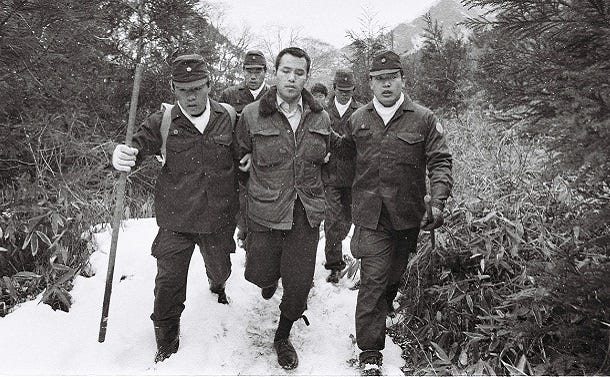
On 16 February 1972, after realizing the police were encroaching on them, the remaining members abandoned their mountain cave in Gunma Prefecture, to which they had moved to evade police pursuit a few days earlier. In order to outwit the police search teams, members decided to take a treacherous winter mountain route to reach the Nagano Prefecture part of the Japan Alps.
Yoshikuni Igarashi, Dead Bodies and Living Guns
The majority of the members were arrested en route, but the last five members, fearing arrest, took a hostage and locked themselves in a nearby ski lodge. A resultant nine-day police siege captured the attention of the nation and inculcated a climate of retroactive interest in the lynching murders once their grotesque results were uncovered.
Isolation and cultishness
The URA may have been fastidiously secular. But it nonetheless borrowed a great deal from the organisational principles of cults and other apocalyptic movements. According to Thomas Robbins and Dick Anthony:
The decline of traditional mediating structures raises the prospect of pervasive atomization and widespread "homelessness" or loss of social rootedness (Berger and Neuhaus, 1977). In fact, however, there is some tendency for declining mediating collectivities to be replaced by emergent "social inventions" (Coleman, 1970) and encounter groups, cults and communes, which operate to detach young persons from exclusive reliance upon the nuclear family for interpersonal relationships and value transmission. Such groups create settings for "extended communal relations transcending kinship ties" and thus constitute "contemporary attempts to create new intermediate relations between individuals and primary groups on the one hand, and traditional … secondary groups on the other, through extended primary relations" (Marx and Ellison, 1975:455). […]
The current proliferation of esoteric movements as well as the evangelical resurgence can be viewed as part of a broader "sectarian reaction to mass society," which is providing an impetus for the emergence of a variety of movements. These groups qua mediating structures have been depicted as performing a variety of adaptive and therapeutic functions for individual devotees (Snelling and Whitely, 1973; Petersen and Mauss, 1973; Marx and Seldin, 1973; Gordon, 1974; Zaretsky and Leone, 1974; Robbins et al., 1975; Bradfield, 1976; Anthony et al., 1977; Anthony, 1980; Galanter and Buckley, 1979). as well as integrative and tension management functions with respect to the social system (Robbins, et al., 1975; Robbins and Anthony, 1978).
Thomas Robbins & Dick Anthony, Cults, Culture, and Community
In a similar manner to those cults that “create settings for ‘extended communal relations transcending kinship ties’,” the URA forced its members into a condition of extreme sociological and geographical isolation via its system of mountain bases. The URA was also closely tethered to a small caste of charismatic ideological leaders—especially Tsuneo Mori and Hiroko Nagata, whose wills came to be identified with the will of the group itself. The isolation of the URA partisans from mass society may have been a natural extension of their guerrilla tactics, but it also had striking impacts on their organisational principles and the psychological posture of its members.
Mori, for example, repeatedly demanded that the members of the group “communise” themselves. This “communisation” of the self was posited as the only method of freeing a would-be revolutionary from their naturally counterrevolutionary disposition. But neither Mori nor his targets demonstrated any clear understanding of what this concept meant in practice. The accusations which motivated the purges of the URA incident—such as failing to prepare enough water bottles or being excessively attached to personal beauty—were so directionless, vague, and broad that communisation came to be defined as a tautological buzzword. Communisation was simply equivalent to doing the ‘right’ thing in whatever revolutionary terms Mori happened to accept in that moment.
Yet, the relative incoherence of the URA incident, as a question of the content of the victims’ behaviour, is far less mysterious when studied in terms of the “standpoint” of the members of the group as revolutionary subjects. According to Akihiro Kitada, “Marxist ideological spaces bring attention to the narrator’s position, intensifying interest in self-consciousness and self-negation as methodological issues of identity formation.”4 In analysing the importance of this fixation, Kitada quotes Michinori Katō, a survivor of the URA incident, who in turn explains that “making a mistake did not stop at admitting fault and declaring ‘I will carry out self-critique’. It also involved digging down and unearthing the original ideological causes of the mistake. Self-critique was a presentation of one’s personal history as the fundamental cause of the mistake, and then an analysis of how one would transcend it.”5 Communisation is consequently defined by Kitada as:
[The effort] by which an individual subject obtains the physicality of a revolutionary warrior via “comradely discussion, mutual debate, and self-critique.” […] Mori’s favoured catchphrase was “from the perspective of communisation;” saying things such as […] “from the perspective of communisation, it is not acceptable to become the centre of attention.” […] It is almost impossible to locate any conceptual core to this “perspective of communisation.” […] However, this does not mean that the ideology of communisation was haphazard or meaningless. It was a meta-ideology of negation that could not be articulated in positive terms. […] The theory of communisation was a network of discourses that sustained a desire for the impossible state of total communisation; this state did not need to correspond to any exact goal or end. […] It is best to think of the privileged position they [Mori and Nagata] held in this discursive space. […] A deified, transcendent authority is necessary to see through the self-deception of self-negation; Mori and Nagata instrumentally took on the role of that authority.
Akihiro Kitada, Laughing Japanese Nationalism
In other words, the operation of communisation in the URA incident was not a matter of behavioural content, but of position. What defined counterrevolutionary conduct—even demonstrably harmless conduct—was that it could not be articulated “from the perspective of communisation,” which was itself instrumentally attached to Mori and Nagata as a function of their hierarchical leadership. This coincidence between leadership and the group’s alleged collective desires may have been rooted in a distorted reading of secular Marxist theory, but one of its practical consequences was an analogy to the organisational principles of doomsday cults and religious extremists.
The “idea” as phenomenon
It is one thing to empirically demonstrate that cults and extremist organisations use isolation as an instrument to—whether intentionally or coincidentally—condition their members for the kinds of violence that we see in the Aum and URA cases, as well as in related fictional depictions such as Tsui no Sora and Subahibi. But this factual finding is insufficient to fully grasp the phenomenon. We also need to develop a philosophical and conceptual account of the inner mechanisms that lie beneath the organisational principles of isolation.
An obvious place to turn is Shinji Miyadai’s description of ontological isolation in contemporary technologised capitalism. Miyadai’s account of the Aum incident rests on the same “decline of traditional mediating structures” and “pervasive atomization and widespread ‘homelessness’ or loss of social rootedness” that is identified by a cause of cultish organisations by Robbins and Anthony. However, Miyadai’s diagnosis refers to a generalised, society-wide condition of social dislocation and ontological isolation. This makes it a slightly different phenomenon from the narrowly tailored isolation that is practised by cults and extremist organisations. As Robbins and Anthony highlight, this cultish isolation is carried out as a response to the wider circumstances of contemporary social atomisation. But Miyadai’s theory does not speak to a cult’s own resultant internal dynamics.
Under Miyadai’s framework, technological atomisation disrupts and fragments the mediating institutions of society. However, we should firstly question why it is that cultish attempts to reconstitute a new community in the place of these institutions lead to a totalising hierarchical structure in the mould of Mori’s theory of communisation. A second question further concerns the reason that this circumstance further carries the potential to erupt into apocalyptic violence. Together, answering these will clarify the fundamental basis behind the Aum and URA incidents. Moreover, doing so will allow us to return to Subahibi with a new analytical lens.
One of the more readily applicable attempts to answer these questions came about directly in response to the URA incident. Kiyoshi Kasai, a former Marxist of the same “[nineteen] sixty-eighter” generation as the participants in the URA incident, made a considerable splash in the landscape of Japanese political thought with the publication of his seminal 1984 work, The Phenomenology of Terrorism: An Introduction to the Critique of Ideas. In The Phenomenology of Terrorism, Kasai attempts to break with the kinds of sectarian and ideological Marxism that he sees as being embodied by the URA incident. He further tries to rescue the revolutionary potential of spontaneous moments of anarchic action—such as the Paris Commune, Russian Soviets, or even the counter-cultural youth rebellion of May 1968—as standing apart from the totalising obligations of Marxism and dialectical materialism. For our purposes, the book is highly illustrative in its detailed attempt to get behind the nature of ideological violence and cultish thinking.
Kasai begins this task with a phenomenological account of ideological thinking as a conditioned state of existence. Kasai structures his vision of the “idea” (kannen) into four basic forms:
● The Self-idea (jiko kannen)
● The Communal-idea (kyōdō kannen)
● The Partisan-idea (tōha kannen)
● The Ensemble-idea (shūgō kannen)
There is a danger of mistaking the meaning of these terms when they are taken as strictly sociological or political categories. Firstly, it should be noted that Kasai’s phenomenology centres human experience, and not abstract things. We can analogise this to another recurring motif for Kasai: the forms and modes of pain as a sensation that is both physically embodied in a spatial dimension and yet deeply personal and interior. Relatedly, attempting to interpret the Self-idea as uniquely subjective, as next to the objective-seeming forms of ideas that correspond to the terminology of the collective group, would be to make a decisive analytical error. All of these forms of the idea are phenomena that humans occupy in the first-person.
However, it would also be a mistake to confuse Kasai’s ‘idea’ with the mental activity of thinking. Kasai’s idea is not equivalent to the process of interiority or the experience of being within a mental process. It is instead concerned with the existence of concepts, understandings, or frameworks as phenomenal appearing-beings in their own sense. “Ideas are thought-things, mental artifacts.”6 In the same typology as pain, the idea dwells within a person, but in some sense comes from somewhere else—somewhere tangibly real and at some distance from the imaginary and thinking processes. This is, in other words, the first-person encounter with comprehensible abstractions as-such.
For Kasai, all ideas are produced through alienation. “The basic character of the idea is ‘self-deception’.”7 This is because alienation and abstraction are, structurally speaking, nearly identical. Any attempt to comprehend the world and retain it will be under constant assault from the reality of the world; not merely because of some empirical contradiction between the two—it is rather that the attempt to hold the world in comprehension, and to enclose or encapsulate it, is threatened by the non-ideational structure of the material real world. Hence, ideas in general correspond to “the ideational restoration of a lost real world.”8
Let us think back through the phenomenology of pain as an analogy: at its causal ground, pain is a product of both the brain and the body. However, pain as a phenomenon does not uniquely privilege either; humans do not feel pain as something held within their brain or in their body; pain lays atop both of its originary locations, in a curious parallax. Pain feels as though it is invading the mind from the outside, but it nonetheless lacks the concrete capacity to be shared with others in the manner of the common physical world. The phenomenal sensation of pain is not located either in the life of the mind or in the world beyond it, and yet it has an undeniable existence of its own, not reducible to either constitutive causal ground. In a related but distinct manner, attempts to grasp phenomena through their abstracted, or alienated, form removes them from any reducibility to their originary location. The idea of a given rock is not located in the rock itself; the alienation of the idea from the rock from the materiality of the rock is definitional to it being ideational in the first place. Nonetheless, reducing this idea to a mental process or to human imagination is not accurate to its phenomenal experience. In contrast to thinking itself, which retreats from the world, the completed idea stands apart in its partially thing-like distance from pure internality. Kasai takes this structure in a novel direction:
The capacity of the self for recovery solely depends on the tangibility of the alienated idea. In order for a lost world to return with substance, the idea must totally negate the immediate reality of existence. In this sense, vague and half-done ideas are inherently contradictory. The precipitated idea leads, inevitably, to the absolutisation and purification of the self. We might say that this inevitability is the physiology of ideas. Takaaki Yoshimoto’s concept of the “object-like distance” of ideas was also discussed in terms of this inevitability. The object-like distance of ideas is merely one of their key elements, but if one also grasps how ideas are supported by an earnest desire to recover a self beyond its own ground in the face of the loss of the world’s reality, one encounters the very site where the ideational emerges.
Kiyoshi Kasai, The Phenomenology of Terrorism
In order to sketch out the consequences of this methodology, we will follow along with Kasai’s “history of ideas” and thereby reach his applied phenomenology of contemporary terrorism. Kasai begins with the emergence of the idea in general through world abstraction. He then proceeds to the specific construction of an opposition of subject and object through and within this space of abstraction. Kasai’s core phenomenon for the first case is, in critical correspondence with Heidegger, death and mortality. “The immediacy of death as an existential experience acts as the founding basis for alienated ideas.”9 Consciousness of death as an always present possibility threatens to totally destroy any stable perspective in the world. It is both wholly inevitable and yet immediately unpredictable. Therefore, abstraction allows the self to distance itself from death’s ever-present possibility: the self as an ideational space, which is thereby alienated from unabstracted existence, is built as a stable location to break off from the ceaseless movement of a concrete reality filled with death. Recall Kasai’s fundamental characterisation of the idea: abstraction, alienation, self-deception, and the restoration of a lost world. The confrontation with mortality renders the state of unmediated being-in-the-world intolerably uncertain; Kasai therefore refers to a “lost world” in the sense of such a flight from the pure and authentic presence of being in the natural world. The self cannot remain ‘itself’ in a world where ‘itself’ is always threatened with destruction.
For Kasai, mortality is both the foundation of the idea and the archetype of its logical physiology. The general form of the idea emerges as an escape from the direct confrontation with death in an unmediated natural existence. But even beyond this initial appearance of death—that is, even as physical death has subsequently found itself recast to a merely supporting role—the evolution of alienated ideas continues in the same pattern as in this general case. The interior of any ideational form is continuously threatened by its exterior; in correspondence with its world-building condition, the idea exists to solidify and stabilise a conceptual space as next to the unstable and fluid conditions that lie beyond itself. In consequence, this means that an abstraction is always being eroded by its distance as compared to its original basis. In other words, the idea is gradually destroyed by its lack of materiality and is therefore driven towards self-destruction and change. This is firstly because of the inherent and unavoidable categorical distance between reality and the alienated idea. And secondly, reality is the site of continuous change, which in turn enlarges this distance in a practical sense. The idea may leave some room for escape from the confrontation with physical death, but ideas will in turn find themselves in an endless battle with their own disintegration by way of their inauthenticity. This ideational form of destruction is effectively a replacement for physical death in this structure. Resultantly, alienation is a never-ending process of reinvention and escape; what begins as the emergence of the idea in general becomes the history of ideas in the plural and their infinite spiral of re-alienation.
A crucial moment in this history is the development of the subject–object divide, and the corresponding “object-like distance” of ideas. The emergence of ideas and their concomitant building of a perspective for the self is, of course, closely associated with what Kasai refers to as the Self-idea. But the Self-idea cannot properly be grasped independently of its dialectical companion in the Communal-idea. The relationship between the Self-idea and the Communal-idea once again features mortality as a familiar core motif. However, this is closer to a sociological reenactment of the initial encounter with death, rather than that moment itself. Nature is a metabolic cycle featuring death as an ever-present and arbitrary force. Standing athwart nature is the human community, which is an enacted conditional space that protects its members from directly confronting the immediacy and meaninglessness of natural mortality. In other words, the human community mirrors key features of the alienation of ideas through the embodied medium of social organisation.
The worldliness of the community in Kasai’s sense is similar to Hannah Arendt’s notion of the worldliness of the world. From such an Arendtian perspective, “the common world must be characterized by a certain stability. It can only be common on this condition, because, amidst an ever-changing flux, intersubjective reference to the same is not possible. To the picture of the with-world and the world as a place of appearance, Arendt hence adds the necessary stability of the world in the form of objecthood and objectivity, and calls this the ‘worldliness of the world’.”10 A common-unity of perspectives within a world-space produces the necessary stability to guard against the risk of ideational death inherent to abstraction. In addition, as discussed earlier, the human community alienates its members from the immediacy of physical death in nature. In other words, the Communal-idea acts as a shelter from both physical and ideational death.
The dialectic of terrorism
In order to unmask the emergence and physiology of the idea, we chiefly emphasised the phenomenological elements of Kasai’s thought. However, his history of the idea does not limit itself to this methodology. Kasai also deploys Hegel’s dialectical method—but with an intentionally ironic bite. Put simply, Kasai adds the Partisan-idea as the sublation (the “synthesis,” in vulgar “Hegelian” terms) of a dialectic between the Self-idea and the Communal-idea. He explains the intentions of this dialecticism like so:
Given the necessity to infiltrate the system of the Hegelian dialectic, the structure of this book, […] will act as camouflage and mask our infiltration; it is the product of a deliberate Hegelian mimicry. This strategy was chosen for a destructive purpose—for turning the Hegelian structure […] inside-out from within.
[…] The first task will be an account of the Self-idea, which serves as the interior aspect of the ideational at the site of its emergence. Next, the movement of the Self-idea must be understood in its relation to the Communal-idea, which is prior to the Self-idea as both a matter of logic and history. […] And lastly, the corruption and collapse of the Self-idea into the Partisan-idea will be laid out. […]
This structure is a parody of the Hegelian system, […] and came into being under the influence of phenomenology in the sense of both Husserl and Hegel.
Kiyoshi Kasai, The Phenomenology of Terrorism
At our current stage of analysis, the fact that “the Communal-idea […] is prior to the Self-idea [my emphasis] as both a matter of logic and history” is absolutely key. It is only through this directionality that we can hope to comprehend Kasai’s “product of a deliberate Hegelian mimicry.” It is correct to identify the Self-idea with “the ideational at the site of its emergence:” the relatively low—almost subject-like—distance of the Self-idea places it within the horizon of the original experience of alienation. However, the recognition and phenomenal perception of this Self-idea as ideational only begins because of the comparative “object-like distance” of the Communal-idea. The common-unity of a world that we experience with others—what Arendt refers to as the “common sense” of a “plural” world of appearances; that is, a space of intersubjective perception—exists prior to alienation and abstraction. Therefore, we discover the abstract and ideational exactly among that which does not appear in the common world. And relatedly, the common sense of intersubjective perception is prior to the idea. Even for unalienated animals, the world is rooted in the stability of as it appears to us all among social creatures. It is only through alienation, and thereby the ideational abstraction, that we discover the appearance of as it appears to me, but not you in the Self-idea. Once this is noticed, it becomes possible to articulate a concept of as it appears to you all, but not me as the physiology of all ideas that are exclusively held in common. The ideational type, as it appears in the Self-idea, brings coherence to a wider sense of the ideational, and not merely material, ‘objects’ of common sense as-in the Communal-idea. It is through the tension between as it appears to me and as it appears to you that we encounter the phenomenal anatomy of subjectivity and objectivity as paired ideational structures.
Another crucial distinction here is that the Self-idea acquires its qualitative determination precisely because its interior encounters a negative exterior, which thereby imposes finitude. The discovery of subjectivity through alienation—the capacity for building our own world after being alienated from the instability of unmediated being-in-the-world—retroactively uncovers its negation in the idea of objectivity in the world created together in the community. This movement suggests a certain point of translation, where the phenomenal observation of ideas as the general product of alienation—as a psychophysical phenomenon—can develop into a procedure where ideas develop into further forms of specific determination in the sense of Hegel’s process-based dialectic of ideas. In plainer terms, Kasai begins with phenomenology in Husserl’s (and other’s) sense to demonstrate the physiology of ideas in general, and he then moves on to the evolutionary development of ideas in the sense of negative determination as-in Hegel.
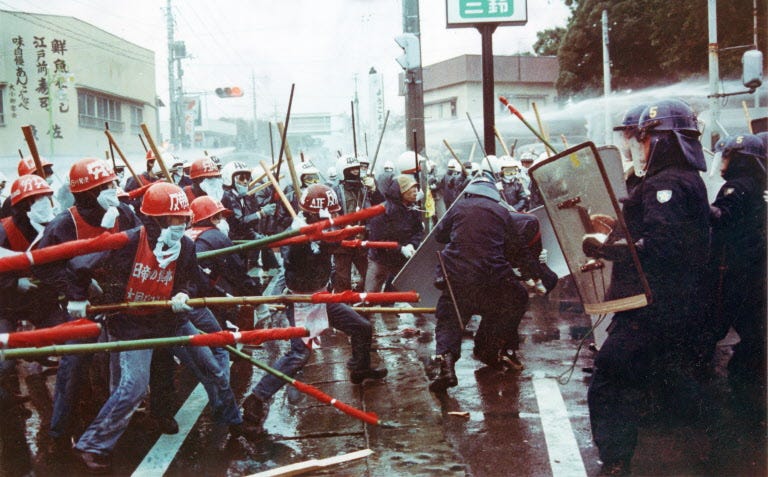
We can demonstrate this processual evolution of ideas in a concrete and comprehensible manner by returning to an applied phenomenology of terrorism. The Self-idea is, in summary, the intermediating ideal world we build for ourselves in order to have a fixed space of existence. The Communal-idea is the sense that there is an ideal world shared in common among others. The commonality of this world gives it an “object-like distance” as next to the Self-idea, and it is by way of this exteriority and objectivity that the Communal-idea finds its sense of worldliness. Insomuch as the Communal-idea contradicts the comparative lack of reality within the Self-idea, the attempt to build a world for the self risks a collapse into worldlessness. This worldless condition must necessarily proceed through a path of destruction and negation:
A person undergoing total worldlessness has already been forced to confront destruction. The only options left for them are destruction in the sense of gradual suffocation, or a more sudden kind. Total worldlessness reenacts itself endlessly, as a continuous sensation of pain and suffering. Unable to feel the world, they cannot accept its reality, but they also cannot reside in the pain and its burdensome authenticity of life. Such a world is only a world for others. It always appears on the other side, like the stage of a play. Its rules and laws are not a source of connection with the world and its people, but only the terror of arbitrary sanction—an artifice of oppression.
Kiyoshi Kasai, The Phenomenology of Terrorism
Yet, it is not as though we can painlessly do away with this Self-idea as soon as it takes on a condition of worldlessness. Human beings cannot escape their rootedness and thrownness within a discrete individual perspective. Moreover, the contrary Communal-idea of shared human perspectives is itself justified by the “necessary stability of the world in the form of objecthood and objectivity.”11 Therefore, both the Self-idea and Communal-idea appear to be absolutely necessary. The problem is that this gap between the two “reenacts itself endlessly,” as Kasai suggests. Insomuch as the apparent “objectivity” of the Communal-idea contradicts the immediate sensations of a particular human perspective, that lone person will find themselves stuck between two incompatible worlds. They must either dispose of their common sense and trust only in their inner experience of perception, or else they must refuse to ‘believe their lying eyes’ and therein surrender entirely to the Communal-idea sustained by others. Both possibilities only lead to a freshly alienated perspective on the world, and they therefore necessitate an encounter with new forms of the idea.
The Partisan-idea, which follows from this problem, is neither strictly subjective nor objective in its phenomenal distance. Its purpose is, as with any idea, the “restoration of a lost […] world.”12 The disunity between the Self-idea and the Communal-idea unavoidably produces a sensation of worldlessness—as the objectivity and stability of a common world can no longer be reconciled to the immediacy of individual human existence. Without this, the Self-idea tends towards idealised hopes and fantasies. The Partisan-idea comes into being in order to objectify the Self-idea’s alienation from the common whole. Its method lies in producing an alternate arena of commonality apart from the general whole. This makes for something of a facsimile of the Communal-idea; the Partisan-idea is a shared idea held in common by a sub-group that defines itself by its incompatibility with the Communal-idea of the ‘general’ or ‘universal’ community. In other words, when the imaginary content of the self is placed in opposition to common sense, it can only be sustained by finding others who share in the same ideal or fantasy. We can only give ourselves a permanence appropriate to existence in a material world by performing that self in the presence of others. And therefore, insomuch as a particular self is excluded from the common-unity of others, they require recognition from the shared perspective of a similarly excluded common-unity. This sub-division of the common-unity is characteristic of the Partisan-idea.
We can also describe the development of the Partisan-idea in Hegelian-dialectical terms. Beginning with a state of alienation from unmediated being, the Self-idea constructs a substitute world within the horizon of individual human perspectives. However, this Self-idea will necessarily differ from the Communal-idea—which is located in the same common sense that human beings use to confirm the objectivity and solidity of the material world. The appearing nature of this Self-idea is originally world-building, but the specification of its boundary as next to the Communal-idea reveals its “determinate negation” in the solitary condition of worldlessness. Through a process of sublation, or positive speculation, a unity in the self-determination of the idea unfolds as the sharing of this internal substitute world. The Partisan-idea describes the capacity for this shared self-world to be realised as a unit of social organisation.
Kasai does not intend for any Hegelian account to be taken literally. His methodology is after all a “parody” of Hegel. Hegel’s method concerns the dialectical self-resolution of ideas. The negative determination of certain immediate historical events unfolds as the processual development of a world-historical absolute spirit of rationality and freedom. Kasai recasts the implicit historical determinism of this method and suggests that the basic phenomenology of ideas inevitably finds its self-determination in the Partisan-idea—which he then characterises as the engine of an anti-rational, domineering terrorism. That is, as having precisely the opposite end to Hegel’s absolute spirit of rationality.
We must therefore consider the connection between the Partisan-idea and terrorism in some detail. It is hardly surprising that the Partisan-idea, as the embodied alienation of the counter-community, would have some correspondence to terrorism: that is, it is a concept that is relevant to counter-hegemonic violence among sub-state groups that do not enjoy general cultural legitimacy or political authority. As a purely linguistic concern, ‘partisan violence’ is simply an older synonym for the modern concept of ‘terrorism’. Kasai deploys the Hegelian notion of negative self-determination to suggest that the logic of ideas demands an endless historical cycle of self-purification. Wherever a gap develops between an idea and the common sense of its exterior, a process of sublation is realised via a purifying sub-division of this dialectical tension into a new common sense.
In Hegel, such a process would be realised in the world-historical absolute spirit of rationality. It would thereby leave open the possibility for a rational and gradual development towards the realisation of a perfected political state, built on the sublated foundations of what once was. This is not the case for Kasai’s model of self-purification. While Hegel’s dialectic implies an immanent contiguity between a final totality and its constitutive dialectical movements, Kasai’s history of the idea tends towards pure destruction. The alternative common sense of the Partisan-idea cannot obtain its necessary solidity and objectivity unless it removes itself from the domain of the Communal-idea. And similarly, any continued distance between individual Self-ideas and the Partisan-idea will resuscitate the world alienation which justified the latter’s development in the first place. This implied mutual incompatibility between the world-building function of different forms of the idea leads to a purifying, destructive kind of dialectical movement. The cycle of world alienation described by Kasai implies the continual abolition of ideas, and not merely their continued development.
When it comes to the relationship between this dialectical movement and concrete violence, one need only think back to the URA incident, which hangs over all of The Phenomenology of Terrorism as the seminal embodiment of the Partisan-idea. The isolation of the United Red Army in mountain bases was intended to develop a revolutionary unity of action. This unity of action can be analogised to the Partisan-idea in a sense that Mori understood as the “communisation” of the bodies of the URA members. This meant abandoning both the positionality of the Communal-idea of outside society, as well as the Self-idea of the prior lives of autonomous individual members. A successful process of self-critique therefore demanded that a member accurately explain how their prior sense of self was determined by the objective processes of capitalist production in the wider community, and then also to subsequently articulate how the unity of perspectives of the URA would allow for the transcendence of both of these standpoints through the “communisation” of the individual self within the group of the URA.
The isolation of the URA corresponded to its systematic intensification as a manifestation of the Partisan-idea. The problem was, firstly, the mutual incompatibility between the Partisan-idea and other forms of the idea. And secondly, the impossibility of total self-purification of the Partisan-idea as an ideological structure. That is, in the vocabulary of the URA, the impossibility of “total communisation.” Once these conditions were in place, self-purification found its only possible outlet in the form of the URA incident. The intensification of the Partisan-idea demands the purification of all lingering remnants of the Self-idea and Communal-idea from the group. And it is only natural for this need to express itself in an explosion of violence, given the equal impossibilities of ideational co-existence and peaceful self-purification. In conventional social contexts ruled over by a mainstream socio-political community, the purifying destructivity of the Partisan-idea tends to be directed outwards towards the Communal-idea—as is the case in the general phenomenon of terrorism and partisan violence. But, contingent on the mix of intensity and impotence displayed in physically isolated situations such as the URA incident, this capacity can transform inwards towards a totalitarian purification of everything and everyone that embodies a standpoint different from the Partisan-idea.
A “Kasaian” interpretation of the “Takuji incident”
For the 1999 visual novel Tsui no Sora, the presence of the Aum incident seems inescapable. A game that was released in that era and features a murderous religious doomsday cult cannot help but evoke the events of 1995. Many of the same general associations naturally remain with its spiritual sibling in Subahibi. However, one notable feature of the depiction of the Takuji cult in all of these games is that its activities are far more insular and self-destructive than the public-facing violence that was carried out by Aum. In this sense, the URA lynching incident makes for an unexpectedly useful analogy to the inner dynamics of the Takuji cult. As we have already addressed, the Miyadai thesis goes a long way towards explaining the general social appeal of groups such as Aum—and therefore, by analogy, the Takuji cult. But if we are to understand the internal ideological mechanisms of the Takuji cult, we must add Kasai’s older analysis of the URA to our treatment of it.
We addressed the catalytic role of death in the events of Subahibi in some detail during our summary of the text. But this is a point that nonetheless warrants some repetition and additional emphasis. The endless everyday existence of the characters in Subahibi prior to the events of July 2012 has much in common with Kasai’s description of the tense dialectic between the Self-idea and the Communal-idea. It is only after a direct confrontation with death and mortality that Zakuro and Takuji each totally lose their grounding in the stability of the Communal-idea—to be precise, the death of Tsubasa Shiroyama for Zakuro and the death of Zakuro herself for Takuji. This is not to say that death alone has a unique, mystical power to cause ontological dislocation or extremist violence. Indeed, both Zakuro and Takuji already suffered from significant and visible trauma due to the abuse they had each already experienced prior to their respective encounters with death. Nonetheless, we can still point to their confrontations with mortality as useful markers for the point where each character lost all faith in the shared concepts of reality which govern the basic “common sense” of mass society.
Even if she articulates the point in accordance with a very different, Wittgensteinian, understanding, Ayana also emphasises the alienation of death as the engine behind the incidents that culminate in the Takuji cult. According to Ayana, humans fear death and have therefore hidden it away. The self-world of the modern metaphysical subject is constructed upon the silent absence of death whereof they cannot speak. As a result, any sudden reemergence of death infringes upon the limits of the self-world and morphs its shape. Ayana refers to this encounter with an absent void as seeing Nyarlathotep, the Crawling Chaos. Nyarlathotep is a malevolent entity from the Lovecraftian Cthulhu mythos. But in Subahibi, there is no specific reason to think that Ayana is referring to a literal eldritch deity. Instead, Nyarlathotep seems to be a form of appearance for the fear of an inarticulable silence beyond subjective knowledge. After the “death” of Kagami, Yuki herself sees a form of Nyarlathotep in the epistemic silence left by Kimura, as another example. Insomuch as death heralds Nyarlathotep, it is because the return of mortality ruptures the boundaries of an everyday common sense that is founded upon the alienation of death.

In Kasai’s terminology, this ideational hiding away of death is nothing other than the Communal-idea. Resultantly, when the Communal-idea is ruptured by the reappearance of death, or by any other appropriate precipitating event, the subject is left adrift in the worldless isolation of the Self-idea without its dialectical partner. The Self-idea will then be assaulted by the unceasing movement and indeterminacy of its exterior reality. In order to survive, the Self-idea must find a stable home for itself. Zakuro and Takuji each seek this home in the outside—or, transcendence—by finding others to participate in a shared idea that is separate from the failed common sense of the Communal-idea. This is the Partisan-idea.
Zakuro embraces the co-ideational structure of the Partisan-idea much more enthusiastically than Takuji; the uniquely solitary charismatic position of the narcissistic cult leader such as Takuji, or such as the URA’s Mori, is ultimately a standpoint that is not given much in the way of a specific treatment by Kasai’s model. Nonetheless, both Zakuro’s pact with Usami Tsukikawa and Ayumi Mizuo, as well as the Takuji cult offer a space for alienated individuals, who stand apart from the Communal-idea, to join in a shared Partisan-idea. This exploding out of the Self-idea into a shared experience of the Partisan-idea is the essence of the cultish search for transcendence.
Zakuro’s suicide has its own logic that is best explored in the specificity of her chapter. But at least with the Takuji cult, its structural similarities to the URA incident highlight the importance of Kasai’s concept of the Partisan-idea. In the context of an isolated microcosm, which is physically and psychologically cut off from the sociological mechanisms of the Communal-idea, such cults are at their greatest risk of a violent implosion. Cult-like organisations that maintain a merely ambivalent separation from wider society are liable to be caught in a kind of antagonistic equilibrium: the group is always surrounded by an immovable outside in the form of the Communal-idea. And while such cults may in time turn to some form of violence, the rigidity of the Communal-idea imposes a certain steadiness and predictability on their situation.
However, a fully self-enclosed Partisan-idea faces the most destabilising possible temptation for any idea—total success. Whether in a secret mountain hideout or an abandoned school building, an organisational closed circle appears to offer the practical opportunity for the Partisan-idea to actually eliminate all traces of the Self-idea and the Communal-idea. The problem is that, at the absolute outer limit of this effort, all ideas encounter the imperfectability of embodied material reality. “Power means a direct confrontation with reality.”13 And when reality takes the form of fragile human bodies, it is possible, even if the result is ephemeral, for mere ideas to appear to destroy reality.
Part Three – Plurality and Materialism
At first blush, it may seem as though the gap between the pseudo-Wittgensteinian viewpoint of Subahibi (the self-world and Nyarlathotep) and Kasai’s phenomenology of terrorism (the Self-idea and world alienation) is simply a matter of preference between alternative vocabularies. Coincidentally, we can exactly point to the late Wittgenstein—as opposed to the early Wittgenstein who is most often quoted in Subahibi—as a thinker that centres such “language-games” and heralded the so-called “linguistic turn” in Anglo-American philosophy. Richard Rorty, a philosopher who stands in an unusual position in-between supporting and opposing such linguistic philosophy, argues that all beliefs and systems of truth claims come in the form of competing “final vocabularies;” by which he means the point-in-time best available vocabulary for constructing the truth as the speaker sees it (truth is always constructed with Rorty). If a superior, more useful vocabulary later appears for describing the given phenomenon, the speaker may swap to that vocabulary and adopt it as their new final vocabulary.
This mode of thinking concludes that the only role for philosophy is developing better vocabularies for achieving practical understanding and action in the world—philosophy cannot “uncover” deeper or more absolute forms of truth. If we follow Rorty in conceiving of philosophy in this manner, it seems as though the overall course of this essay has been to move backwards. Sca-Di’s chosen Wittgensteinian vocabulary is arguably more evocative and more practically useful than Kasai’s as a psychological description of the immediate experiences of Subahibi’s characters. Introducing Kasai into the discussion only moves us from a dynamic, inward-looking vocabulary that is well suited to the ennui of the Lost Decades, back to an antiquated political vocabulary centred on the rigidly ideological terrorism of the 1970s. A centrepiece notion of Rorty’s is that philosophy can never reach an absolute conclusion, because it must always develop new vocabularies in order to historicise itself and respond to the new circumstances that arise across time. Kasai’s anachronistic model has clear limitations if we wish to follow Rorty’s lead and properly historicise our thinking.
However, Rorty, for his part, has another biting critique of conventional philosophy that I would like to highlight in my own response to Subahibi: Rorty argues that one of the most serious defects a philosophical vocabulary can have is that it is not able to be taken “seriously.” By such “seriousness,” Rorty here means the capacity for its adherents to behave and think as though its conclusions were actually true. In what follows, I will argue that Subahibi’s philosophical viewpoint, while somewhat compelling in the context of fiction and in certain thought experiments, runs into deeper problems if we attempt to take it seriously in this sense. And more to the point, I will argue that insofar as circumstances permit it to be taken seriously by certain people in certain times, those circumstances are a provisional, politically conditioned state of existence that can and must be refuted on its originary political, and not philosophical, grounds.
Cartesian meditations
René Descartes famously inaugurated modern philosophy in accordance with the principle of radical doubt. For Descartes, nothing is to be simply believed or supposed as given. According to his procedure, philosophy ought to operate as though there is a powerful demon capable of generating perfectly convincing illusions. Since the philosopher would therefore be unable to trust anything they see or feel, they can only proceed from that which can be absolutely proven as independently true beyond all possible doubt. In laying out this method, Descartes also tells a story about the Greek mathematician, Archimedes:
I shall pursue my way until I discover something certain; or, failing that, discover that it is certain only that nothing is certain. Archimedes claimed, that if only he had a point that was firm and immovable, he would move the whole earth; and great things are likewise to be hoped, if I can find just one little thing that is certain and unshakeable. I therefore suppose that all I see is false; I believe that none of those things represented by my deceitful memory has ever existed; in fact I have no senses at all; body, shape, extension in space, motion, and place itself are all illusions.
René Descartes, Meditations on First Philosophy
Archimedes’ argument was that the whole world, when taken together, must have a holistic mathematical and physical nature as an object. Since all objects obey the laws of physics, they can be moved by an appropriate physical lever. Archimedes reasoned that if he stood outside of the world and used a perfect lever that was proportionate to the world, he would be able to lift the world using this lever. Descartes applies this parable to the problem of knowledge. If the philosopher can find the one thing that is true, independent of the unreliable objective world, they will be able to use this singular unit of knowledge as a lever to lift and understand the world.
Philosophy underwent radical changes between the time of Descartes and the kinds of contemporary thought that shows up in a story like Subahibi. Corresponding to these shifts, Subahibi does not “doubt” the world in this traditionally Cartesian sense. Rather than doubting the world, Tomosane Mamiya is in fact radically open to the givenness of the world: “it’s all just the world. It’s all just my world. […] I don’t really feel like I’m alone in the world. You’re right in front of my eyes, so you definitely exist.” But there is a difficulty with this apparent openness. Tomosane’s analysis operates through Wittgenstein’s conclusion that “solipsism strictly carried out coincides with pure realism. The I in solipsism shrinks to an extensionless point and there remains the reality co-ordinated with it.” The metaphysical subject here can regard the world as being as they see it—the world is simply their world. The existence of content beyond this self-world is a practical certainty. However, this content must be regarded as technically absent because “whereof one cannot speak, thereof one must be silent.” This approach is reasonable enough on its own terms, but does it really coincide, as told, with pure realism?
Declaration 1 of the TLP reads “the world is everything that is the case.” Declaration 1.1 reads “the world is the totality of facts, not of things.” Declaration 1.11 reads “the world is determined by the facts, and by these being all the facts.” These basic opening propositions form the methodological foundation of the TLP. When Wittgenstein later develops a concept of the “metaphysical” subject whose limit constitutes the world, this extensionless point as the world is by definition the boundary of all of the facts that can be understood and which make up the logical ground of existence. Hence, declaration 5.6, “the limits of my language mean the limits of my world,” corresponds to the limits of articulable understanding. Wittgenstein’s world is not an ontic world—not a world of perceived object-things.
In an earlier section, we discarded the problem of the “creativity” in Subahibi’s reading of Wittgenstein as unimportant for understanding Subahibi’s viewpoint on its own terms. But in this case, the difference between the two is of capital importance for everything that follows. The plausibility of Wittgenstein’s coincidence between solipsism and pure realism hinges on the fact that his solipsism is a solipsism of facts and not things. The world is everything that is the case, and this everything is an everything of atomised facts. When a rock leaves the perception of the subject, the constitutive atomised facts that allow for the existence of the rock remain within the world of the subject as the facts that constitute what is the case. It is not a problem for the realism of the world when the subject turns around and loses sight of the immediacy of the rock.
But Subahibi’s application of solipsism is slightly different. In Subahibi, when the subject turns around, the rock escapes into inarticulable silence. The only way for the rock to permanently enter the world would be if the metaphysical subject took up, like Descartes, an Archimedean point where the universe appeared as a totality that could be lifted into the brain using a figurative interpretative lever. Subahibi here returns to a kind of fundamental Cartesian doubt of the material outside.
What kind of Archimedean point could serve this function? Descartes’ own choice lies in the most famous phrase in the history of Western philosophy: “I think, therefore I am.” Subahibi, however, does not accept this line of reasoning. To be sure, Tomosane does take the givenness of the sensory world as beyond dispute. But he makes a further distinction through the claim that there is no outside and that the given world is simply his world. Ayana annotates this conclusion with the argument that the subject is the limit of the world in the special sense that everyone together shares one subject. Put another way, Subahibi posits a kind of intersubjective Archimedean point. Lifting the world is possible only as such a collective enterprise.
The most complex problem here lies in the reason for the game’s choice to entertain the leap from Tomosane’s intersubjective givenness to Ayana’s intersolipsistic pantheism. It does not present this conclusion as absolute or obligatory by any means, but the attention it pays to the mere possibility of pantheism is itself a clarifying feature of Subahibi’s worldview. By this I mean to ask and answer the following challenge: why is the eternal transmigration of the soul not simply discarded as a silence whereof we cannot speak, in the same manner as other unprovable theories on the same scale? We might name this decision, to speak whereof it could not, as the significant non-silence of Subahibi’s epilogue.
Despite positing the speculative possibility of a pantheistic Archimedean point, Subahibi never goes as far as suggesting that the psychological individual has any means of accessing this standpoint. To be sure, the Tsui no Sora Remake’s epilogue does leave some room for Spinoza’s argument that the transcendent sub specie aeternitatis is comprehensible to humans in principle. But on the whole, Subahibi’s own argument for the eternal transmigration of the soul, which would constitute such an Archimedean point, is not a positive argument. It does not affirmatively suggest that this single-soul theory is true. Instead, it lets itself doubt the alternative. The fact that one soul is sufficient to explain the world is given as reason enough to doubt the existence of a second soul.
The benefit of Wittgenstein’s dictum that “whereof one cannot speak, thereof one must be silent” is that it circumvents the reductionism of other forms of scepticism such as Cartesian doubt. In the traditional model of doubt, the entire material world falls into metaphysical peril because one cannot prove its underlying reality. But in a system of atomised logic such as the early Wittgenstein’s, we can simply take the constitutive facts that arise from experience as our world, whilst remaining silent as to the distant foggy shores of the object-world’s own ontic reality. In other words, we need not doubt if we simply circumscribe our comments to the factual language of experience.
But Subahibi lets itself return to the frame of radical doubt for exactly one thing: the otherness of others. It does not doubt their givenness and their bare existence in the self-world of the subject. The solipsism of Subahibi is entirely open to the existence of others, since it situates those others as an obvious sensory fact of experience. Common sensically, by sheer simplicity, the default interpretation that arises from this experience of otherness as it is presented up through the end of Jabberwocky II is that the existence of others coincides with their own individual subjectivities. This is the understanding that Tomosane operates under in his theory of self-worlds. And it is only overturned through a procedure of doubt by Ayana during Tsui no Sora II. By introducing such doubt, Subahibi steps away from any particular conclusion regarding the structure of intersubjectivity. It equivocates by making both possibilities seem equal.
When viewed in this light, we can see that the decision to speak on this doubt has the practical effect of disrupting the presumptive, common sensical validity of the multiple-soul interpretation of otherness. It is as if to say that the multiple-soul assumption is so problematic that it warrants the dramatic step of Ayana speaking whereof she cannot actually speak. While it remains the case that Subahibi does not explicitly affirm the single-soul interpretation, it at least disagrees with the alternative to such a degree that it is willing to speculate beyond the limits of its own methodology in order to overturn it. On its own, this “shortcut” in reasoning is not terribly significant. Its end result is simply a move from one doubtable conclusion to two doubtable possibilities. However, we should not let it escape our attention that this shortcut is what allows a purely speculative Archimedean point to enter the worldview of the story. I will posit here that the structural impossibility of ever reaching the Archimedean point—of reaching the Spinozaist sub specie aeternitatis—under the multiple-soul interpretation is the very thing that breaks the tie and forces a leap into unprovable speculation.
Doubt and otherness
The full consequences of the above manoeuvre will only come into view if we carry out our own analysis of otherness from a very different standpoint to Subahibi’s pseudo-Wittgensteinian solipsism. But even in saying that, we would do well to remember the chief merit of Subahibi’s approach: that is, the seriousness with which it centres human experience as prior to logical and metaphysical speculation. The problem is that this strength is also the location of an equivalent weakness, in the sense that this deference to experience never quite grasps the priorness of the world and of the other as structuring conditions of existence.
The world is always experienced as one’s own world in the sense of being the horizon of consciousness. However, I mean this exactly in opposition to the solipsistic allegation that the world is interior to the brain. The brain is not wider than the sky. Consciousness never appears to itself as itself; “all consciousness is consciousness of something.”14 Consciousness enters the sky in the sense that consciousness-of—attention—focus—care—opens itself up to the sky. To say that the brain contains the sky would be to say that the sky has been locked away in the one place that consciousness cannot find it.
The obvious refutation that might follow this argument is to say that all experience is ultimately reducible to the physical processes of the brain. However, a curious feature of this approach is that these physical processes are exactly what we mean to be inaccessible to consciousness. We cannot get behind consciousness and see our thoughts before they explode out into consciousness. The brain is a disappearing causal ground and only its subsequent output appears before us. To confuse a cause with the phenomenon that it causes is a particularly tempting form of misunderstanding which we must resist.
Ironically, the only way for an individual’s brain to become the direct object of their consciousness is to use modern science to reproduce an image of their brain, and then to place it out within the world. Of course, even such a representation does not allow consciousness to ever overlap itself with the physical processes at its causal ground.
Subahibi itself relies on a similar identification of experience with the world when it follows Wittgenstein in defining the subject as an extensionless point that coincides with pure reality. The problem is that this experiential self-world is a contingent delimitation of apprehension. Experience becomes the world, and the world becomes experience. By contrast, to say that consciousness overlaps with the world is only to say that one has consciousness-of the world; it is not to say that the world is consciousness. Moreover, such consciousness-of the world in its totality remains impossible insofar as we mean a consciousness that belongs to individual human beings. There is no vantage point from which to open individual consciousness up to the whole world like Archimedes lifting the world from its outside. That said, Subahibi left open the possibility of this vantage point as an intersubjective standpoint of universal experience—beyond otherness. And hence, we land on the meaning of otherness as a central problem.
If the world is “my” world, as Subahibi maintains, the apparent existence of others is only conclusively the appearance of “my” others. The possibility of an Archimedean eternal transmigration of the soul is so attractive precisely because it refutes the otherwise problematic possibility that these others have their own worlds that stand apart from “my” world. If other self-worlds exist, the coincidence between “the” world and “my” world comes to seem dubious. It takes on the air of a return to vulgar idealism, rather than a philosophy that faces up to concrete experience or pure realism. The essence of otherness is this sensory appearance of that which breaches the selfness of the self-world. It is the facticity of existence beyond self experience. So long as there is a possibility of this form of an outside, Tomosane’s assertion that “there is no exterior or anything” is incomplete. It can only in turn be justified through Ayana’s doubting of otherness.

I would like to borrow from the vocabulary of Emmanuel Levinas to think through this condition of beyondness. For Levinas, selfhood is defined by a totalising self-relation of the constituent features of conscious experience; the self is “the being whose existing consists in identifying itself, in recovering its identity throughout all that happens to it.”15 Consciousness never appears to itself as itself. It appears as a disparate coordination of experience. Rather than itself as itself, consciousness is an experiential consciousness-of-and-in a world. Such a world operates as a site of consciousness. We exist as an always already world-enclosed awareness-of worldly thereness. But this worldliness of the world is not sufficient on its own to ground the phenomenon of otherness: The world, “the site, a medium, affords means. Everything is here, everything belongs to me; everything is caught up in advance with the primordial occupying of a site, everything is comprehended. The possibility of possessing, that is, of suspending the very alterity [otherness] of what is only at first other, and other relative to me, is the way of the same. I am at home with myself in the world because it offers itself to or resists possession.”16 In other words, the world on its own is taken up in the self’s negotiation with its limits; we try to “suspend the very alterity” of the world; we try to take hold of the world and make it “my” world.
Such a taking hold of the world and the constituting of a self-world is the core ontological phenomenon of Subahibi. In the pure contact between self and world, the self colonises the world. The self overlaps itself with the world that appears in the limits of its consciousness-of. “This reversion of the alterity of the world to self-identification must be taken seriously. […] The identification of the same is not the void of a tautology nor a dialectical opposition to the other, but the concreteness of egoism.”17 The point is not whether or not this movement lands on something that resembles Subahibi’s solipsistic egoism. Rather, we should pay attention to the process of totalisation itself as the foundational structure of egoism. Totalisation encloses the world and thereby equalises otherness and selfness. In this sense, totalisation is not subjectivity; totalisation posits itself as everything, not as alterity—a difference between self and other. “Subjective existence derives its features from separation.”18 As with Kasai, even the totalisation of selfness appears with an “object-like distance.” This all must be specified to say that our dispute with the self-world structure is not a relitigation of the subject–object dichotomy, but rather a consideration of the problem of totality.
Recall that in Subahibi the difficulty lies in the moment that this totality is ruptured by the appearance of an otherness that resists assimilation within the self-world. The question is therefore how to interpret this appearance of otherness. Subahibi’s answer is to nonetheless doubt the otherness of the other, and to equate it with the self-world. That is, to strip it of its alterity. If we ask, “how can the same, produced as egoism, enter into relationship with an other without immediately divesting it of its alterity?”19 Subahibi opens the door to the possibility that it simply cannot. But we already laid out our own difficulties with this self-world model. For this reason, we will choose to follow Levinas in seeking a fuller account of the phenomenon of unassimilated alterity.
Some elements of the world resist self-totalisation as a function of simple obscurity. We might, for example, say that the answers to the most recent New York Times Crossword are absent from “my” existence if I only completed the Wordle. But this is a very trivial form of otherness, even as it is necessarily one of the most commonplace. Otherness of this kind is structurally assimilable to self-totalisation simply by appearing to consciousness. Even the most dogmatic solipsist can contend with this form of otherness. If the other is nothing other than the unperceived which is capable of becoming the self—as is the structural implication of this assimilability—it can be defined as a non-existence that comes into existence in coincidence with its appearance. In other words, as a kind of ontological denial of object permanence; once you leave my sight, I cannot prove your existence.
A more contentious and significant phenomenon is to be found in those forms of otherness that resist assimilability even when they appear to consciousness. The tendency towards self-totalisation corresponds to a specifically ontologising mode of apprehension, which fills itself with consciousness-of the instrumentality and thingness of the world. In contrast to this ontological gaze, Levinas highlights that “the notion of the face, to which we will refer throughout this work, opens other perspectives: it brings us to a notion of meaning prior to my Sinngebung [creation of meaning] and thus independent of my initiative and my power.”20 Levinas’ reference to a “face” is simultaneously conceptual and literal. It is other human beings in the moment of a face-to-face encounter whose depths are unassimilable to an ontology of “me” and “my world.” In the human face, we see a boundary-line to the perfect foreignness of another’s conscious experience. It stands for a form of existence that is absolutely beyond our own reference to a bounded totality.
Insomuch as totality constitutes itself by enclosing existence, the mere unassimilability of that which resists totality produces a sense of boundlessness and indeterminacy. Levinas refers to this transformation as an “infinition of infinity”—the unfolding production of an endless beyond. The proper response to the otherness of the face-to-face is to embrace the idea of infinity; to treat the other as an endless depth that is truly and absolutely beyond the delimited totality of our own self-determined identity.
This orientation does not allow us to step over and include the other in our ontological consciousness-of in the sense of gaining knowledge which supersedes doubt. To do so would be nothing other than possessing the other and extending the domain of totality. “Theoretical thought, guided by the ideal of objectivity, does not exhaust this aspiration; it remains this side of its ambitions. If, as this book will show, ethical relations are to lead transcendence to its term, this is because the essential of ethics is in its transcendent intention ["intention" is jargon for consciousness-of]. […] Already of itself ethics is an ‘optics’. It is not limited to preparing for the theoretical exercise of thought, which would monopolize transcendence.”21 Therefore, otherness is not a transparent ontological fact that is to be proven through naked knowledge. It is a pre-ontological obligation of the ethically conditioned reality that we are born into amongst appearing others—who precede our ongoing ontological negotiation with identity, and who will also ultimately succeed us even beyond our death. In lieu of an ontology, the beyond “imposes itself upon meditation in the name of a concrete moral experience: what I permit myself to demand of myself is not comparable with what I have the right to demand of the Other. This moral experience, so commonplace, indicates a metaphysical asymmetry: the radical impossibility of seeing oneself from the outside and of speaking in the same sense of oneself and of the others, and consequently the impossibility of totalization—and, on the plane of social experience, the impossibility of forgetting the intersubjective experience that leads to that social experience and endows it with meaning.”22
Insofar as otherness remains a form of non-knowledge that is subject to doubt, it might seem as though we have arrived nowhere. However, the point is that otherness shapes and determines experiential existence prior to ontologised knowledge. Everything that we know, we come to know after having always already taken otherness into ourselves as a constitutive foundation. “The idea of infinity is the mode of being;”23 ethics is an optics, a way of seeing that already fills the consciousness that carries out “I think” to locate “I am.” The search for a beyond is not an arbitrary and hopeless search driven by despair, as Kimura speculates in Subahibi. The infinition of infinity already appears through the face of the other as the facticity of unassimilability, which exists in the world from the moment of birth. This is why Levinas famously insists that ethics is the first philosophy—that human alterity is constitutive of consciousness at a level below even Kant’s transcendental apperception which grounds all further philosophy.
We can summarise the above to say that otherness as otherness is phenomenally a priori. Therefore, the capacity to reject such otherness must arrive a posteriori as a “seeing through” of some allegedly fallacious semblance. Basically, otherness appears to be authentic otherness in the structure of conscious experience. The question is whether there is a basis to reject this appearance—to say that the world as it appears is deceptive. Mere doubt is insufficient for this task. If otherness unprovably appears to be true, this is only to place it on the same level as the material world and all of the other apparent phenomena that Descartes doubted. Insofar as otherness seems to be beyond knowledge in a sense that is not true of, say, a physical rock in the material world, this is, as above, only to say that we possess and totalise the rock within an onto-physical horizon of things that do not resist my control. This is a phenomenologically significant distinction to be sure. But its significance therein depends on the decision to bracket—to suspend judgement on—fundamental doubt. From the perspective of fundamental doubt, both the rock and the other are equally silences whereof one cannot speak. An additional force is necessary to “take seriously” the non-otherness of the other within the boundaries of accepting conscious experience in the world.
To jump to our conclusion and make a drastic claim, this force must be understood first and foremost as a political phenomenon.
Politics and the disappearance of the other
Despite being non-phenomenological, Subahibi nominally accepts the premise of thinking from within the horizons that are given to conscious experience. But as we have seen, it then takes the peculiar step of doubting the otherness of the other even when this otherness appears as itself to conscious experience. In a sense, Subahibi hopes and prays for the sub specie aeternitatis to rush in through the space opened by this ambivalence: Letting this possibility hang overhead allows it to rescue the otherwise imperiled claim of solipsism and to place it within the appearing world of conscious experience. This "possibility" is not something that we ourselves can or want to dispense with through doubt. Solipsism is possible—in exactly the same sense as Descartes’ demon is a mere possibility that produces further mere possibilities. The question is, within the world of appearances, what are the conditions that foster such a convincing dream of solipsism? How does an idea that we can entertain or believe as idle speculation, but which we also cannot ordinarily, in Rorty’s terms, “take seriously” in our behaviour and thought, transform into a vividly manifest social reality?
The overriding condition of our era, as Shinji Miyadai surmises, is a kind of ontological isolation. This atmosphere of isolation infuses both Tsui no Sora and Subahibi on a fundamental level. It was naturally front of mind during the chaotic close of the millennium, when the first of these games was made. And its relevance did not disappear by the time of the second in 2010. The fact that the society of recent history—a society characterised by population growth, urban density, and technological interconnectedness—should be in the midst of a kind of crisis of isolation may at first seem mysterious. Unraveling this mystery will unmask the particular features of isolation as a political phenomenon.
Of course, to make sense of this effort, we first need to take the basic step of describing what we mean by politics. The fact of human multiplicity and alterity is pre-determinative of human experience, as Levinas brings to light. However, the experience of human togetherness that sprouts up from this foundation takes on further layers of meaning in the course of its ascent. People do not appear before one another as a neutral, sterile abstraction of a face. Particular social and economic structures tie certain people together, and their respective alterities are thereby bound up in the relational contexts that constitute their encounter. Biologically speaking, the most basic unit of this connectivity is the family or the tribe. It is only once these are in place that the stranger, for example, can appear with the specifically signified alterity of an outsider. Similar procedures of enclosure mark out other such social designations—language, religion, culture, class, gender, etc. (These boundaries are overlapping and can take on a variety of shapes.) As a kind of definition, we will refer to the posterior structures of alterity, such as these among many others, as “politics.” This is why we can say, by way of an example, that the otherness of the foreigner is a “politicised” otherness, as opposed to the “pure” otherness of the face as-such.
Isolation in a correspondingly pure sense is relatively self-explanatory: to be isolated is to not be around others. Isolation is any consciousness-of where other people do not appear. Various forms of isolation are significant, but yet others are utterly trivial in content. Deep thinking is generally a solitary activity, but so is shitting. Some people prefer to eat alone. Some people prefer to sleep in isolation. Even on our increasingly densely populated, urbanised planet, there are ample opportunities to experience this simple and direct form of isolation.
To be isolated in a political sense is to lack access to a significant conditioned structure of alterity. An isolated person can be an excluded outsider who is unable to enter an already apparent political constitution. But political isolation can also come about simply from lacking the capacity or numbers to form a group with others in the first place. Both of these forms of political isolation are characteristic of tyrannical government: in a tyranny, the organs of the state exclude their opponents from all public institutions and place significant limits on the creation of competing political organisations. Nonetheless, this tyrannical oppression is far too narrow in scope to implicate the fundamental categories of ontology or to bring about widespread solipsism. Tyrannies and dictatorships are only truly concerned with challenges to their own power. As a result, their targets are almost always the forms of political existence that implicate public life. Private forms of organisation rarely attract their attention. Therefore, even if tyrannies enact political isolation as a deliberate instrument of their power, they do not (and cannot) make it into a general rule.
Even in light of these qualifications, we can make use of the example of tyrannical isolation to elucidate the general principles of political collectivity and organisation. The tyrant must make use of isolation because its opposite—popular unity—generates a space of public action and establishes the conditions for exercising political power. For understandable reasons, our contemporary understanding of politics is heavily weighted towards the analysis of political ends. Surrounded by mature and well-studied organs of political power as we are, the question has become what goals that pre-existing embodiment of political power ought to be used for. However, the obvious fact that political power flows towards certain results and achievements, and that these outcomes are interesting in their own right, is ultimately a distinct problem from the capacity of people to act and generate political power in the first instance.
An isolated individual can of course act on the world in an ordinary and strictly ontological sense. A person who throws a rock takes total possession of the rock and its subsequent place in the world. But when people act together their sheer multiplicity marks the action with different meanings and procedures as next to the lone actor. What kind of action takes place and who it goes on between is necessarily refracted through the embedded structures of alterity that constitute each who, or face, that is implicated in the moment of action. People who act collectively do so through the medium of the groups that they speak for by acting, and the groups that they act upon and between. Collective action thereby forms politics at the point of intersection between structures of alterity. Acting together enmeshes the action in a politicising field.
If we apply this understanding, we will see that the monopolisation of political power by the tyrant and the widespread sensation of isolation amongst their tyrannised subjects are just two sides of the same coin. Isolation is a necessary and expected component of being unable to enact political power with others. However, as discussed, insomuch as tyranny produces isolation, it does so as an instrumental means to wield exclusive political power. When we look to the phenomenon of solipsism, the form of isolation that we are pointing to is different from and more fundamental than this byproduct of classical political injustice.
In her analysis of totalitarianism, Hannah Arendt usefully points to a different possibility. When isolation penetrates far beyond mere political repression and becomes a total phenomenon, its effects correspondingly morph into something unrecognisable in the terms of traditional political theory. Arendt refers to this total form of isolation that infuses even private forms of life as “loneliness.” The distinction between isolation and loneliness is not just a matter of scale but also one of fundamental ethical character: In order for the sensations of political isolation to extend across all forms of social interchange, and not just those public-facing nodes of visible political power, the various boundary-lines and structures that constitute private identity must be effaced and sterilised. Loneliness does not just force political identity out of public spaces in the manner of tyrannical isolation; “loneliness is not solitude. Solitude requires being alone whereas loneliness shows itself most sharply in company with others.”24 In other words, for loneliness to be operative, togetherness must become impossible even in the midst of any number of one’s peers.
According to Arendt’s analysis, loneliness is systematically paired with regimes of state terror. And by terror, she means the intensification and totalisation of violence for the purpose of paralysing self-instigated political action amongst individuals. “Terror seeks to ‘stabilize’ men in order to liberate the forces of nature or history.”25 Arendt further marks out the following technical features of terror:
Terror is separate from violence for the sake of power. Resultantly, terror is its zenith “when it becomes independent of all opposition; it rules supreme when nobody any longer stands in its way.”26
Terror must be so universal that it extends even to those who are not conscious enemies of the regime. This means that it must be indifferent to the true guilt or innocence of its victims; its violence must seem arbitrary, or even random.
Terror must operate omnidirectionally across all elements of society, rather than relying on the transparent top-down hierarchies of traditional police authority. It therefore must make use of secret police, informant networks, and the like. Every apparently private group or organisation must feel as though terror might be in its midst.
Once these conditions are in place, loneliness naturally follows. Terror in such a form allows the same general principles of isolation which appear in tyrannies to transmute themselves into vapor and float like droplets on the wind. When tyranny is everywhere, the uniquely public–private structure of isolation shifts into the universal experience of loneliness—where all forms of human togetherness are prohibited and, therefore, people lose their specifically individualised forms of appearance. Politics is the system of belonging and exclusion that inscribes the particular contents of identity onto the face of the other—we might call this result a “persona.” A human society where everyone is frozen in place by terror and incapable of enacting political forms of existence loses sight of these personae, and thereby becomes a society of naked faces. The body of the other is thoroughly anonymised and dissolves into a mass of indistinct alterity.
Although this bare alterity may seem like a “return” to Levinasian ethics via the reversal of its posterior politicisation, the reality is anything but. In Levinas, the face-to-face encounter is a moment of infinition that smashes the boundaries of consciousness. It is a dynamic spark that elicits an ethical demand for reciprocal justice, rather than an unconstrained vision of total liberty for the self. In a system of interchange with an ethically recognised other, the question of who they are is naturally paramount. Politics is the particular human fact of an enacted structure that facilitates an answer to this query. If left to follow its natural course, a naked face will be clothed by politics via its entry into the world of others. Any assembly of people who communicate will display themselves and be seen by others; “living things make their appearance like actors on a stage set for them. The stage is common to all who are alive, but it seems different to each species, different also to each individual specimen. Seeming—the it-seems-to-me, dokei moi [δοκεί μου, “my perspective”]—is the mode, perhaps the only possible one, in which an appearing world is acknowledged and perceived. […] And just as the actor depends upon stage, fellow-actors, and spectators, to make his entrance, every living thing depends upon a world that solidly appears as the location for its own appearance, on fellow-creatures to play with, and on spectators to acknowledge and recognize its existence.”27
The paralytic force of terror and loneliness does not merely strip the political world of communicability in the language of personae. It also freezes alterity in a state of mute nakedness. As a result, no one is capable of responding to an address of their otherness. No one has access to the structures necessary to answer the question of who they are. In the absence of this political potentiality, ethics cannot self-perpetuate its characteristic motion of infinition. Without the motor of politics, ethics coagulates and turns to concrete.
One significant result of this final disappearance of otherness is the corresponding disappearance of the world itself. Recall that in Levinas’ account of the self-totalisation of ontology, the world is enclosed and possessed by the self—it becomes identical with the individual subject. It is only the infinition of infinity in the face of the other that explodes this delimitation of the world. The facticity of a beyond that we cannot possess appears before us and quite literally stares us in the face. And in turn, the appearance of this otherness in a shared world moderates the self-totalisation of that world: The fact that the world is filled with others who participate together in its materiality makes it our world and not my world. That is, embodied otherness fills even the world of objects with a form of reality that is separate from its naked possession by the self. In this sense, Arendt hits the mark when she writes, “even the experience of the materially and sensually given world depends upon my being in contact with other men, upon our common sense which regulates and controls all other senses and without which each of us would be enclosed in his own particularity of sense data which in themselves are unreliable and treacherous. Only because we have common sense, that is only because not one man, but men in the plural inhabit the earth can we trust our immediate sensual experience.”28
At this outer extreme, loneliness is a political pre-condition for taking solipsism seriously as an embodied way of life. The experience of living amongst people who are unable to exist as equal standpoints instantiates the possibility that ideas—the products of the brain—are the substance of reality, rather than the shared world that we would otherwise verify through the existential fact of otherness.
Philosophers have always been free to speculate on the theoretical division between idealism and materialism as competing metaphysical conclusions. But only the disappearance of plurality and alterity can make solipsistic idealism dominant in the concretely enacted practice of political life. And politics, not philosophy, structures how people actually live and feel in our world of appearances.
The only remaining mystery, then, is the odd reality that either of these clearly destructive phenomena came to be at all. As mentioned throughout our considerations, any would-be ruler can rely upon the coincidence between tyranny and isolation to secure their claim to political power. These two concepts are directly related to power in a manner that is not true of the comparatively wasteful pursuits of terror and loneliness.
Concerning the historical emergence of terror as a tool that is available and imaginable for the state: that question is far beyond the possible scope for this post. Interest should instead be directed to the core books on the subject—Arendt’s own The Origins of Totalitarianism, Michel Foucault’s The History of Sexuality, and Giorgio Agamben’s Homo Sacer, to name a few. But the experience of loneliness, which also happens to point directly back to our main subject, is something that we can tackle here. Our topic, after all, was never the highly specific if explosive historical meaning contained in an event such as Nazi fascism. Loneliness is our true target.

Terror inculcates such an extreme sense of loneliness that it ruptures the entire concept of a political system. But this use of terror to artificially spread loneliness to every corner of society is not the only form—or most accurately, the only degree—of loneliness that appears in contemporary history. The transformations of the recent past—especially the developments of capitalism—have unfolded into a sense of social atomisation that lurks everywhere like background radiation. Like Miyadai understood, to live in a technologically mediated capitalist society is to live in a society that appears to proceed autonomously through technical, inhuman procedures. And capitalism does not stop at the boundaries of public power in the manner of a classical political tyranny. Capitalism infuses every aspect of private existence. Its content is primarily economic after all—with “economic” being derived from the Greek for the management of private home life. The isolation that corresponds to this system is unbounded by the limitations that would otherwise prevent it from becoming a weak form of loneliness.
To ask and answer a very basic question: Why, then, are people who are in the midst of this loneliness attracted to the kinds of groups that most intensify this same experience? The answer, if we think back to Kasai’s analysis, can be found in the natural movement of the idea. A community—a world-making form of human togetherness—is maintained in tension with the individual’s own ideas. If conditions arise which smash the validity and credibility of the ideas which sustain this community, the opposed ideas of the self will be uprooted and set loose. The Self-idea is worldless and disorienting on its own. It desires a world to root itself in, and ultimately to possess. We should analogise the resultant colonising gaze of the Self-idea directly back to the Levinasian understanding of ontology and self-totalisation; Kasai’s analysis is consciously informed by Levinas after all. At its extremity, the “lonely” experience of being amongst a mass of naked faces, who are stripped of all of their specific political content, is exactly the only way to live in a stable world where one’s ideas become the only shared “reality” of the world. After all, this experience is not called “loneliness” when it is encountered on a temporary basis in ordinary life. In those instances, it is instead the "ecstasy" or “transcendence” of the crowd—or even, the communion of the religious congregation or the “out of body” energy of a concert hall. Suspending all difference and relationality is, perhaps counterintuitively, a means of accessing a “high” of perfect trans-subjective overlap that feels “more real” than the precariousness and imperfectability of actual communication.
The problem is, firstly, that if left to fester, this "high" of artificial transcendence suspends politics, ethics, and everything that is actually transcendent about living our lives amongst others.
Secondly, but perhaps even more importantly, we should recall the violent conclusion that lurks within Kasai’s dialectic of ideas. A “lonely” state of togetherness is unerringly fragile. Politics always threatens to rush back into it—through individual differences within the group (Self-idea), and through the differences with exterior groups (Communal-idea). Such invasive ideas push alterity back into motion and destroy the ecstatic unity of the Partisan-idea. Moreover, the ideational nature of the idea is itself at odds with material reality. The self-negating movement of the idea is impelled by its fragility in the face of materiality. There is no final end to the idea that can permanently free it from the shackles of this reality. The Partisan-idea’s limit ultimately lies in a momentary confrontation with its own material existence vis-à-vis the human body. People, through the sheer material fact of being different consciousnesses-of and standpoints in the world, will always carry the capacity to politicise alterity again and demolish any ideational world. Arendt acknowledges this fact in the context of totalitarianism: Despite the efforts of terror regimes, the only space and time in a totalitarian society where the idea truly surpasses the material fact of human plurality is in the extermination camps, where humanity is sacrificed for the sake of an idea. Even a microcosmic instance of the Partisan-idea must reckon with this same calculation if it wants to become “real;” the desire to abandon the material world is the eschatological centre of the doomsday cult and the inner contradiction of the extremist cell.

Conclusion – The End Sky
Yuki, sometimes I think about these things. Where is the limit of the world? The very edge of the world. If such a place existed… Suppose I was able to stand in that place. Could I look at the scenery from that edge, just like anywhere else? If I think it’s normal to wonder about these things… Does that make me weird? I mean, that’s the edge of the world. It’s the limit of the world. If I could see that with my own two eyes, wouldn’t the limit of the world become the same as my own limit? Wouldn’t the world, viewed from that spot… be the world that I see? Wouldn’t that be my world? The limit of the world would become the limit of my world. The world is that which I see, touch, and feel. Then what is the world? What is the difference between me and the world? Is there a difference? The difference between me and the world. This is what I have to say. There is no difference between me and the world. Of that I am certain.
That conviction leads me to another question. What is a world that also includes other people? If I am the world, then what about the other people? Do they have worlds too? Then are they separate worlds that don’t intersect? Or is it possible for them to intersect? Out of all the worlds and all the souls… Is it only possible for each soul to see one single world? The scene I saw at the end of the world. The limit of the world. The furthest scene. At that time, were you looking at the edge of the world too? The sky you saw at the edge of the world. The sky at the limit of the world. The furthest sky. Will I be able to see it with you? Will I be able to see the end of the same world with you? Even as we stand under different skies, we look out from under the same sky.
Sometimes I think about these things. Even as I think back upon… That hill covered in sunflowers.
The sky is the central metaphor of Subahibi. The sky seems to be the limit of the world. However, the content of the sky is endless. The universe expands—constitutes itself as space and time—faster than light and quicker than thought. If Archimedes stood outside of the universe in order to lift it into his brain, his lever would dig into a bottomless infinity and never find its mark. Subahibi admits that this fact of an infinite universe means that there is no way to leave the world. There is no edge to the world. This much is correct.
“The subject does not belong to the world but it is a limit of the world.” (TLP 5.632) When Yuki and Tomosane stand at the apparent edge of the world and look into the endless abyss of space, the infinity of the universe coincides with their conscious experience. The world they see, they argue, must be contained in the brain. Therefore, their brains contain infinity. Their selves, like the universe, have no edge. “The Brain — is wider than the Sky — For — put them side by side — The one the other will contain With ease — and You — beside.” There is no beyond and no exterior. The world coincides with the self. If an infinity can appear within the brain, it is a lesser infinity insofar as it can be included within the limits of the self-world. There is no untraversable infinity in the world; every apparent infinity is contained within the self. This is where the problems begin.
Beginning with a confusion between cause and effect, this solipsistic move to the brain obscures the proper meaning of infinity. In Levinas, the infinity of the other is infinite because it is exterior to self-totalisation. The face is right in front of your eyes, but you cannot possess it. It is the facticity of a world that exceeds thought and exceeds selfhood. At root, the sky is actually the same. Tomosane and Yuki’s notion that they have possessed the infinity of the sky is fundamentally false. The sky is not in their brains, it is a material fact of the world that we share together. But the sky nonetheless seems different from the otherness of the face-to-face in certain key respects. The sky is infinite, but it is made up of what we theoretically know to be mere objects. If the ontological self can possess and enclose all kinds of matter, why not a whole universe made up of matter? Despite common sense, it feels as though we could lift even the infinite universe if we could find the right lever that allows us to transcend space and time. The solipsist may begrudgingly admit that there is no Archimedean point waiting for them beyond the physical edge of the universe. But this admission runs against their desires. The objecthood of the sky tempts them to think they can reach out and grasp its infinity. They at least hope, inasmuch as the brain is wider than the sky, that the self might contain infinity and already be identical with an Archimedean possibility.
The story of Subahibi has its origins in the despair of an economised and demystified society that makes human plurality feel like a mere abstraction. As compared to the murky existence of other people, solipsism seems to be eminently credible.
In Tsui no Sora, this same atmosphere is channeled into a story about the horror of aspiring towards an everyday existence under such conditions. The characters in Tsui no Sora share a vision of an End Sky—a sky that has a determinate beginning and end, and which heralds the destruction of the whole world. Contrary to the always promised happy life under capitalism, people rejoice at the possibility of this final end. This is because they live in a lonely world that proceeds autonomously without their input. There is no transcendence and no infinity—not in the face of others, and not even in the sky. What they desire over anything else is something truly beyond. They want something to shatter their worldless, lonely, endless everyday existence. The death of Zakuro coincides with the promise of exactly this possibility: the promise that the world will end on the 20th of July.
We previously referred to Nyarlathotep as “a form of appearance for the fear of an inarticulable silence beyond subjective knowledge.” But under conditions of pervasive loneliness, the mind is uniquely open to the oblivion of such nothingness. Nothing, as Hegel understood, is the most immediate and universal form of infinity. Every instance of being reveals nothing as its negative. To-be implies the abyss of not-being. A truly unexpected and incomprehensible event, such as the reappearance of naked death in the midst of the community, smashes the perfunctory common sense, which was at least restraining the mass of lonely, atomised individuals under its domain. These individuals greet this great “nothing” with fear, but of the kind that one carries in the presence of a god. That is, the appearance of nothing brings ecstasy and escape from the circumscribed boundaries of loneliness and meaninglessness. The destruction of the old ideas by the nothing on their outside is a glorious event in the eyes of those who desperately clung to the hope for change and emancipation from the everyday.
The members of Takuji’s cult did not necessarily join it with the intention of committing suicide. The cult was just the spatial and institutional embodiment of Takuji’s promise that the coming of the 20th of July would take them from a “false” world to a new “real” one. In the context of a cult, people could finally experience something “outside” of their own body through the ecstasy of the crowd—as well as through certain time-honoured rituals for this purpose such as group sex and drug use. In an enclosed space beneath the school, the facts of their own lonely selves and of the capitalist society around them each disappeared. All that remained was the idea of their unity, and its coordination with the “fact” that their world—their Sky—was to End on the 20th of July. And when Takuji took them to the roof of Building C to travel to their “new world,” that idea reigned supreme through to their final moments.
Subahibi responds to the maliciousness and nihilism that is fundamental to this earlier story and its history in the 1990s. The point is that Yuki and Tomosane ultimately manage to look up into the sky and see something seemingly different from the End Sky. The End Sky is the false infinity of a determinative and enclosed nothing. It is the horizon of existence opened up by an encounter with Nyarlathotep, where the denial of the self and the desire to “end” is the only form of transcendence that can open up to a lonely, nihilistic person. It is a solid and uncompromising limit at the end of their world. But Yuki and Tomosane look up into the infinite expanse of space and see that their own worlds are without limit. There is no absoluteness or pre-determination lurking beyond life. Life is simply life, governed by the limitless command to “live happily.”
This effort is admirable. It has something of the poetry that one wants in a work of art. But it is also hopelessly and fatally philosophical. It answers a crisis of the world—our world—by retreating inwards to the life of the mind. Despite the growth it shows, Subahibi remains a child of its parent game and of its history; its cure is symptomatic of the disease. It stubbornly holds onto the dream of solipsism because, like its predecessor, it is the product of a lonely, atomised society that can no longer see reality in its specifically political character. And the crisis of our times, the phenomenon that drives the social collapse shown in Subahibi and which drove the historical context that infuses every aspect of the game, is in its core substance a crisis of politics, not the philosophical problem of individual happiness. Our crisis is the fact that our society, nominally built by and for humans, has become mediated in such a way that it obscures the human purposes that lie at its foundations. People experience a world that feels as though it proceeds autonomously without their input and without providing a home that they can share with others that they recognise in their otherness.
When Yuki and Tomosane see the universe, they do not really see it in its infinite character. Ultimately, no one in Subahibi sees the sky in a sense that would mean access to our material world that is secured in its reality by the otherness of others. Even when infinity is right in front of their eyes, they alienate it—transform it into an idea, a thought-thing. It becomes their End Sky, the boundaries of a solipsistic box they lock themselves inside. They transcend inwards and find their limit in the brain. In the place of Nyarlathotep and a doomsday, they see a far more banal but no less erroneous ideological illusion: They falsely conclude that their chief obligation, over and above the political and ethical ties to others that actually constitute our home in the world, is to merely “live happily” in their Wonderful Everyday.
Notes
Taken from the Charles Ogden translation. This can be read online using this nifty little website.
Cf. Yasushi Kunō, The Truth of the Asama-sansō Incident
Various quotations are presented throughout this section regarding the factual events of the URA incident. When not separately cited, these are all taken from the article Dead Bodies and Living Guns: The United Red Army and Its Deadly Pursuit of Revolution by Yoshikuni Igarashi. (https://doi.org/10.1080/10371390701494135)
Akihiro Kitada, Laughing Japanese Nationalism
Akihiro Kitada, Laughing Japanese Nationalism
Hannah Arendt, The Life of the Mind
Kiyoshi Kasai, The Phenomenology of Terrorism
Kiyoshi Kasai, The Phenomenology of Terrorism
Kiyoshi Kasai, The Phenomenology of Terrorism
Sophie Loidolt, Phenomenology of Plurality: Hannah Arendt on Political Intersubjectivity
Sophie Loidolt, Phenomenology of Plurality: Hannah Arendt on Political Intersubjectivity
Kiyoshi Kasai, The Phenomenology of Terrorism
Hannah Arendt, The Origins of Totalitarianism
Technically Emmanuel Levinas in Outside the Subject, but this quote is famously Levinas’ summation of the viewpoint of Edmund Husserl
Emmanuel Levinas, Totality and Infinity
Emmanuel Levinas, Totality and Infinity
Emmanuel Levinas, Totality and Infinity
Emmanuel Levinas, Totality and Infinity
Emmanuel Levinas, Totality and Infinity
Emmanuel Levinas, Totality and Infinity
Emmanuel Levinas, Totality and Infinity
Emmanuel Levinas, Totality and Infinity
Emmanuel Levinas, Totality and Infinity
Hannah Arendt, The Origins of Totalitarianism
Hannah Arendt, The Origins of Totalitarianism
Hannah Arendt, The Origins of Totalitarianism
Hannah Arendt, The Life of the Mind
Hannah Arendt, The Origins of Totalitarianism